
Category: recruitment

  • Would You Pay to Have Your Resume Read?

    Would You Pay to Have Your Resume Read?

    As a job applicant, would you pay to make sure someone reads your application?

    Here’s a sad reality for many people applying for a job:

    • Their competitors (i.e., other candidates) use AI tools to mass apply.
    • As a result, hiring companies are flooded with applications, and sifting through all of them is impractical.
    • What follows is that hiring companies defer to other AI tools to filter out the vast majority of applications (often as much as 95%+).
    • The recruitment game becomes one of prompting one AI agent to pass through the filters of another AI agent.

    Realities of Job Seekers A.D. 2025

    Imagine that there is a job that you really want to get. It doesn’t even matter why. It may be because you know that the company is great, or the job profile matches your dreams perfectly, or you perceive the experience you’d get there as unique, or whatever. You just want in.

    But hey, since all those other people are using AI tools to spam the hiring company’s application form, your submission will disappear in that flood.

    It’s even worse than that. If you hand-craft your application to show your genuine care for the job, it’s almost certain that you’ll be rejected. After all, your original story will be written to a hiring manager (a human), but it’s never going to get there in the first place. It will be rejected by an automated AI tool (a bot) precisely because it’s non-conformist.

    Such a resume doesn’t match the most common patterns. There aren’t many similar examples in the AI model’s training data. It’s not common enough.

    If you want your application to get past the AI filter, you kinda have to play the game everyone else does. Optimize for what a bot wants. And it’s impractical to do it by hand. Just hire another AI agent to do it for you.

    Except that you’ve defeated the purpose that way. First, you aren’t more likely to get through. Second, even in the case that you do, the hiring manager will see another similar, bland-but-professional resume. You will not stand out.

    Most importantly, you will not carry over your care about that job.

    Recruitment in the AI Era Is Irrevocably Broken

    The story above neatly pictures how broken the recruitment has become. What’s more, there’s no going back.

    You can pretend it’s 2020 and send your manually-crafted CV, but you’re going to lose to people auto-submitting thousands of AI-generated resumes. Oh, and said resumes will be automatically tweaked to better match a job description, with no human effort whatsoever.

    A resume doesn’t work as a token of information exchanged between two humans (a hiring manager and a candidate) anymore.

    The career of a resume is over. At least the one that we know. If anything, a CV becomes a token exchanged between two AI agents, neither of which is programmed by the actual candidate.

    No matter how hard we try, there’s no coming back. We can’t make resumes unbroken again. Even if we aspirationally tried to restore the original meaning of a CV, there will always be a rogue player who will exploit that trust by mass-applying with generated stuff. And since that will give them a short-term advantage, others will follow suit.

    Winning the Game by Not Playing It Altogether

    It’s ironic how both sides of this equation—recruiters and candidates alike—are losing in the new setup. Candidates have it harder to show their care about specific jobs. Companies give up on the best matches because they employ a bot to reject 95% of applicants. And yet, no one can change the rules anymore.

    So, is conforming to the new state of things the only option?
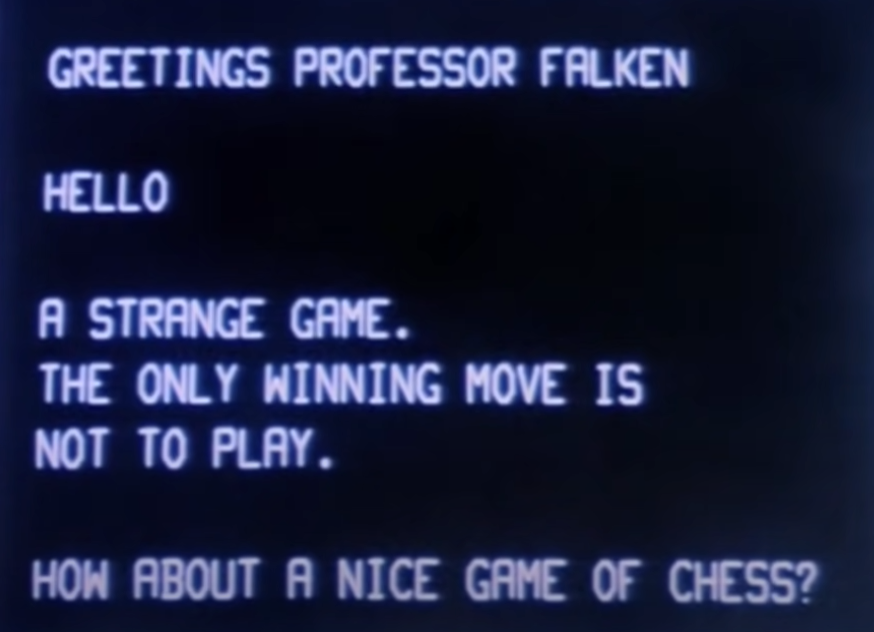
    wargames a strange game
    Image from the WarGames movie

    In the classic movie WarGames, the AI, which is trying to “win” the nuclear war, eventually learns that it always ends in mutual assured destruction. The only winning move, thus, is not to play at all.

    It’s the same with recruitment. If the current system forces us to mass-produce thousands and thousands of resumes that no one will ever read, we’re just adding noise to the system. The winning move? Not to play.

    But wait, if you want to change jobs, how are you supposed not to play the game? If you never apply, you never get that dream job of yours. Or a better one than you have now.

    Trust Networks as Antidote to AI Slop

    In recruitment, as much as in any other area, we will defer to trust networks to circumvent the noise. The more toxic AI slop is in the feed, the less we trust the feed altogether, and the more we rely on human-to-human connections.

    One side of relying on trust networks is that companies increasingly go for employee referrals rather than traditional open recruitment processes. That doesn’t solve the other part of the equation, though. What if I am a candidate and want that specific job?

    Do the same. Build a connection with someone at that company. We live in an interconnected world, and there are still places where a genuine message will stand out. They may attend local meetups, be active on LinkedIn, maybe publish a blog or a Substack, or engage in some other professional activities. If you care, you will figure that out. Get to know people first, and only then apply.

    Does it seem like a lot of effort? That’s precisely the point. It shows how much you care.

    Very recently, we made our first hire in almost two years. We didn’t even open a recruitment process. There was this guy who stayed in contact after we talked a few years back. And then, eventually, it was a good time for him and a good time for us. A win-win.

    The point is: he made the effort to reconnect. He made it easy for us to remember.

    This could only happen because we’ve built the human connection beforehand. We were two parts of the same trust network.

    Would You Pay To Put Your Resume at a Hiring Manager’s Desk?

    I admit, relying on trust networks is a lot of effort. And it takes time. Both would make the approach impractical at times. So what if there were a shortcut?

    That brings me back to my original question. As a candidate applying for a job, would you pay to skip the AI line? Would you pay to ensure that your application is read by a human?

    Note, your resume would still go through regular scrutiny. It’s just you’d know a human would do it, not a black-box AI agent.

    There’s an interesting balance here. Make it too cheap, say $0.02, and it changes nothing. People would still be mass-applying all the same, so no one would take that seriously. Make it too expensive, say $200, and it’s probably not a good return on investment for a candidate. After all, no one would hire such a candidate or even rate them any better. A hiring manager would just read and assess the resume as if it passed the AI filters.

    What’s in it for a candidate? It’s an open avenue to show genuine care. Since the applicant knows they’re not going through AI, they are free to optimize their application for a human reader. Hell, they actually are encouraged to go the extra mile with their application.

    What’s in it for a hiring company? I reckon it wouldn’t make sense for a candidate to pay for mass applying, so they’d do that only for jobs they actually care about. So the hiring company gets a token of care along with a resume. Recruiters can still assess skills the way they do, but before committing any effort in interviews, they clearly know which candidates consider the position a great match.

    So, would you pay to guarantee your resume is reviewed by a hiring manager? If so, how much?


    Here’s a little experiment that’s in the spirit of the post. This link here is a token of human effort behind the post.
    https://okhuman.com/CuC1uw

  • AI Has Broken Hiring

    AI Has Broken Hiring

    Late in 2023, at Lunar, we were preparing a recruitment process for software development internships (yup, we somehow hadn’t jumped on the “you don’t need inexperienced developers anymore” bandwagon). However, ChatGPT-generated job applications were already a concern.

    Historically, we asked for small code samples as part of job applications. The goal was to filter those who knew the basics from those who just aspired to become developers eventually. Granted, it wasn’t cheat-proof, but that wasn’t the goal.

    It was enough to tell the basics:

    • Was it more toward a naive solution or more toward the optimal end of scale?
    • Were there tests, and if so, what kind of them?
    • What about readability?

    Sure, you could ask a developer friend to write it down for you, but you’d eventually show a lack of competence at the later stages. Heck, we even had a candidate asking for a solution at a discussion group. But these were fairly rare cases.

    Recruitment in the AI Era

    So it’s late 2023, and we know the trick won’t work anymore. ChatGPT can generate a reasonable answer to any such challenge. Eventually, we decide against any coding task and simply ask to share a public GitHub repo. Little do we know, we’re way deeper in hiring in the AI era rabbit hole than we could have ever dreamed.

    Sure, we understand that people will feed ChatGPT with our job ad and have it generate output. After all, as always, we provide a great deal of context about what we want to see in the applications. That makes LLM’s job easier.

    We state explicitly that we seek genuine answers, and we’ll discard those blatantly generated with ChatGPT. Also, no LLM is an expert in who the candidate is, right? No LLM is an expert in me.

    We’re a small company. Till that point, our record was around 90 applications for the internships. Typically, it was maybe half of that. This time, we receive almost 600.

    Despite all our communication, most of them were generated by ChatGPT.

    AI as the First Filter

    OK, it’s no surprise. Instead of creating thoughtful and thorough answers to 4-5 questions, each taking at least a couple of paragraphs, now we can just feed an AI model of our choice, and it will produce as much text as anyone needs.

    Companies response? Let’s use the same models to tell which resumes we should even read. Otherwise, it’s just too many of them.

    ai in communicaiton

    And yes, in our case, I read each and every one of those 600 applications. Well, at least the parts. If the first paragraph has “AI-generated” painted all over it, and the question literally asked you not to generate your answers, then my job was done. I didn’t need to continue.

    By the way, the next time I will do the same. However, we are oddballs. It’s now the norm for the first filter to be an AI model that decides whether to pass an application on to a human being.

    In other words, the candidates generate applications with AI to pass through an AI filter.

    Do you see the irony?

    Just wait till someone starts putting hidden prompts in their resumes. Oh, wait, someone has definitely tried that already. I mean, if the researchers do that in a much more serious context, applicants trying their luck is an obvious bet.

    Hiring Noise

    Now, extrapolate that and ask: What does the endgame look like? More and more noise.

    Let’s just wait till we have AI agents that automatically apply to jobs on our behalf with no human action needed whatsoever. Oh, who am I fooling? There already are plenty of startups pursuing this path.

    jobcopilot website screenshot

    The promise is that you will be able to send hundreds of applications in one click. That’s great! You increase your chances! Or do you?

    Even if you do, it will only work for a very short time. Then everyone else will start doing the same, and suddenly every hiring company is flooded with tons upon tons of applications.

    What will they do? Yup, you guessed it. They’ll pay another AI startup to automate this job away. Most likely, they already have.

    We can easily increase the number of CVs flying over the internet by a factor of 10x or 100x. We still have only 1x of attention from hiring managers.

    The AI Era Hiring Game

    The early stages of recruitment will increasingly be like two AI models playing chess (while neither having an actual model of what a chess game is). One will try to outplay the other.

    An agent playing on a candidate’s behalf will try to write an application that will pass the filters of a hiring company’s agent. The latter, in turn, will attempt to filter out as many applications as possible while still keeping a few relevant ones.

    Funnily enough, I’m guessing that what will make you pass through the AI filter will not necessarily be the same things that would make you pass when a human being reads your resume.

    LLMs optimize for the most likely output. So “standing out” isn’t necessarily the optimal strategy.

    I remember when an applicant drew a comic book for us as their application. It sure caught our attention. I bet an AI model would dismiss it. Oh, and yes, she ended up being a fabulous candidate, and we hired her.

    Which doesn’t mean drawing a comic book guarantees you a job at Lunar, of course.

    If we were to believe startups operating in the recruitment niche, these days, hiring is just a game of volume. Send and/or process more resumes, and you’ll find your perfect match.

    What Is a Perfect Match?

    I’ve been recruiting for more than two decades. I’ve made my share of great hires. I’ve made a lot of mistakes, too. Most importantly, though, I’ve made oh, so many good enough hires who have ultimately turned out to be excellent later on.

    It doesn’t matter how extensive your hiring procedures are. After a week of close collaboration, you will know about the new hire more than you could have learned throughout the whole recruitment process.

    Applying for a job is like submitting an abstract for a conference’s call for proposals. A great talk description doesn’t mean that the session itself will be great. It just means it is a good abstract. And that the person who submitted it is probably good at writing abstracts. It tells little about what kind of speaker they are.

    By the same token, a great resume is just that. A great resume.

    What we’re doing in recruitment with AI is we set almost the whole limelight on the applications. It becomes a game of writing and analyzing CVs.

    Last time I checked, no company was trying to find a person who was great at writing resumes (or more precisely: getting an AI model to generate a resume that another AI model would like).

    Renaissance of Good Old Coding Interviews

    It’s no surprise that physical coding interviews are gaining popularity again. Increasingly, using the AI tooling of choice will be allowed and encouraged during those. Ultimately, that’s how developers work every day.

    After all, these interactions were never about knowing the answer. OK, they should never have been about the answer. They should have been about how a candidate thinks, iterates their way to a better solution, and when they deem it good enough. They should have been about working together with another professional. About all those intangibles that we don’t see unless we have an actual experience of working together.

    We will see more of those. And there will be more of those happening on-site, not remotely. As a hiring person, I want to understand what part of someone’s train of thought is their creativity and what came as copypasta from ChatGPT (or Claude Code, or whatever).

    There’s no shortage of code-generation capabilities. We still don’t have a substitute for judgment, though.

    Why Is Hiring Broken?

    So far, so good, you could say. We return to proven tools and focus on what really matters.

    Yup. That is as long as we’ve cut through the noise. Next time we open internships at Lunar (and we will), I expect more than a thousand applications. Sure, many will be crap, but there will be plenty of work to figure out which will not. The effort needed to navigate the noise grows exponentially.

    Under the banner of “we are improving recruitment,” we actually did a disservice to both parties that play the hiring game. Candidates complain that they send lots and lots of resumes, and they don’t even get any responses anymore. Hiring companies have to deal with a snowballing wave of applications, which means that finding a great match is nearly impossible.

    That much for good intentions and improvements.

    All it took was to remove the effort required to prepare an individual job application. The marginal cost of thinking of and typing those five answers in a form is gone, and thus we can spray our resumes everywhere with one click of a mouse.

    Thank you, AI, for breaking the hiring for us.

    (And yes, I know it’s all us, not AI.)

  • Lateral Skills Are Core Skills

    Lateral Skills Are Core Skills

    We can consider so many things both in our professional and personal lives as value exchange. The most obvious case: I exchange 40 hours of my time each week for a set amount of money that lands in my bank account each month.

    As a business, we do the same thing. We commit our engineers to spend their time on whatever our clients need them for, and in exchange, we receive an agreed-upon rate for each hour of that effort.

    In fact, I often use that frame when describing how we perceive our contributions. We aspire our clients to be happy with the value we deliver for the price they pay for the whole team.

    What Is Value?

    Now, the tricky part in these examples is value. While we can easily assess how many hours anyone spends on a task, the time doesn’t automatically translate to value. What’s more, it’s not even purely a matter of how one will spend that hour.

    I can work on an activity that has only certain odds of success. If the outcome ultimately emerges as a failure, no value will have been delivered. The reasons for that may be entirely outside my sphere of control.

    As an example, think of all the effort I invest into helping a potential client improve how they will approach building their new product just to see them choose a different partner. In this case, my work has not yielded any value for Lunar.

    However, even if I work on something that we assume to have intrinsic value, it’s still tricky. Let’s look at adding a feature to a product. (And yes, I know that not every feature is value-adding. In fact, there are some whose net value would be negative.)

    Assuming the feature I’m building will have a positive effect, the big question is how big of an impact and how much our client values it. That question is almost universally highly challenging.

    Most of the time, we can’t know the answer upfront. We need to build the thing to be able to validate the outcome. Most of the time, however, we don’t try to check that anyway. Even if we did, most of the time, the early validation will now give the complete picture.

    Think of The Shawshank Redemption. Its theatrical release was largely a flop. And yet, over the years, it gathered a strong fanbase, still keeps the #1 position as the best movie ever at IMDB, and eventually, it at least paid off production costs. Not a bad outcome for a flop, eh?

    While there obviously is a correlation between the opening weekend box office and the eventual financial success of a movie, we can’t precisely know the financial success/failure just after the first few days.

    The same goes for value assessment in most of the knowledge work. You could just as easily consider whether paying an employee any specific salary yields a valuable (enough) outcome. And the smaller chunk of work you look at, the more the mileage will vary.

    Making Value Exchange Work

    We use two basic coping mechanisms to work around uncertainty about value.

    The first one is ignoring the actual value altogether and sticking with our early assumptions of what we expected it to be. It’s like deciding to build that feature because “it will bring us so many new subscribers” and never looking back. Sure, before committing to the development, we might have asked for an estimate. If it was acceptable enough (and the work didn’t take much longer), it was the last time we did any assessment of the work.

    We thought it would bring us a ton of subscribers, and it was a sound decision to pay $10k for that. Oh, and since we already paid for that work, who cares whether it actually brought a single new soul to our solution?

    Well, I’d say this means giving up on a ton of learning here, and that’s of huge value by itself, but I clearly must be wrong, as very few product organizations do any post-release validation.

    The second way to dodge the uncertainty of value is by looking at a bigger whole. I don’t try to assess whether an engineer has been productive during every single hour or day. Heck, I’d be perfectly fine with a slower week, too. However, I want to know whether their long-term performance justifies their salary.

    By the same token, I want the whole team working for a client to deliver good value for money in the long run. So, if we look at the weeks or months of work of the whole group, we are happy with the value of everything they deliver (of course, in the context of what that effort costs, again, in total).

    In extreme cases, you could look at movie studios or VCs investing in startups. They are happy to weather plenty of bad investments as long as that one movie or that one startup yields a 100x or more return.

    Lateral Skillsets

    We all make one subconscious assumption here. That is, even though we exchange different things, they are of similar value for both parties. If we ask for $90 an hour for our developers, that hour would be priced roughly a similar way, whether by Lunar’s client or me. Or rather, we would price the skills our client rents for that hour similarly.

    This assumption, though, often doesn’t hold true.

    To stick with the engineering/software development context. When our potential clients want to assess our team’s skill set, it will almost always be heavily skewed toward technical skills. After all, when you hire developers, they will do development, right?

    But let me redefine the situation here. Imagine you seek someone to turn your idea into an MVP. You have two candidates with very similar technical skills. However, one builds their experience by working on many different small engagements, including several very early-stage products. The other spent big chunks of their time working on very few large and complex solutions.

    Which one would you choose?

    I bet most of us would go with the former over the latter, as we’d deem their experience more relevant. This relevancy, however, stems from a lateral skillset. It’s not an ultimate value. It’s value in the context.

    Product management skills may actually emerge as the most crucial for that role, even if we don’t consider it so upfront. At the early stage of product development, building the wrong thing is rarely salvageable. Building the thing wrongly, on the other hand, can typically be saved.

    If we had considered a different gig, we might have chosen differently.

    This is but one example of lateral skills that may make or break any endeavor. A broad range of people skills, project management savvy, business context understanding, and more may be similar game-changers here.

    And yet, without the specific context, the broad market would largely ignore those traits. Even within the context, they are most often omitted.

    Asymmetric Value Exchange

    The lateral skills are what change the economy of the whole value exchange. The job market would value two similarly technically skilled developers, well, similarly. After all, across a wide variety of challenges, they will provide comparable value.

    However, within the early stage product development context, the first one will deliver something extra. They wouldn’t be working extra hours, their code wouldn’t objectively be better quality, they wouldn’t be faster.

    Yet something that costs nothing extra to that developer–their lateral early product management skills–would be highly beneficial for the product company.

    That’s what breaks the simple economy of value exchange. I add to the mix something that’s of little to no cost for me but gives the other party a big upside.

    In other words, I give up nothing while they gain a lot.

    Suddenly, the whole deal has so much more wiggle room, which can be used to make it more attractive for both parties.

    Not only that, though. It also generates additional options for value delivery. Our developer may use their time building a feature that ultimately will not help. However, thanks to their experience, they can also suggest (in)validating the whole part of an app prior to committing to development. That, in turn, may lead to much more significant savings.

    In this case, exploiting lateral skills makes the value exchange asymmetric. Why is it important? It’s because whenever you can find a partnership with an asymmetric value exchange, it’s a plain win-win scenario for both parties.

    Since lateral skills typically create these scenarios, we should pay much attention to them.

    Side Skills Are Core Skills

    If I looked for a technical partner to help me with an early-stage product, I would primarily be looking for stories about discovery work, building MVPs, validation, etc.

    As a matter of fact, I’d be explicitly asking for failure stories. I mean, we know the data. New products do fail. So, if the only thing someone has to show is a neat streak of successes, you can be sure they’re in a fantastic realm.

    One of my mantras is, “Many of our past clients paid us to fail, so you don’t have to. You get all the experience we got from that as a part of the package.”

    These lessons do not fall into what’s commonly perceived as “core skills” for software development teams. And yet, we do consider them core. We shine most when we’re able to utilize those side skills.

    So, go figure out what constitutes those lateral skillsets in your context. These are the core traits you should be looking for, whether hiring or choosing a partner in your endeavors.

  • Cultural Fit versus Cultural Fit

    There is a remark on hiring I’ve heard quite a few times recently. It’s about sending a rejection message to a candidate. It goes along the lines: “Just don’t tell them that they’re not a good fit for the culture. That’s bullshit. That means nothing.”

    A Bad Fit

    I can’t say that such a remark lands well with me. I do, however, understand where it is coming from. As the industry, we started paying attention to the culture. It’s on our radars. We may have only a vague understanding of what organizational culture is but it is already a part of the discourse. This vagueness of understanding of the concept actually comes handy when there’s no tangible reason to reject a candidate but we still somehow didn’t like them.

    They are a bad cultural fit.

    Whatever that means.

    See, the problem I have with many of these statements is that they’re used as a bludgeon without much thought invested to why “we didn’t like” a candidate. Because of that we often throw the baby out with the bathwater.

    A Good Fit versus Likability

    When hearing about lack of cultural fit I often follow up ask what it means that a candidate wasn’t a good cultural match. The answer, most often, is something like “that’s a person we wouldn’t get on well with”, or “that’s not a person I’d like to hang out with”, or “it’s not my kind of a person”. These boil down to how likable a candidate is for an assessing person.

    The problem is that likability is a terrible way of assessing cultural fit. Not only is it not helpful, but it is also counterproductive.

    If we chose likability as our guiding principle to judge cultural match we would end up with a group of people similar to each other. They’d have similar interests, many shared views and beliefs, etc. We would be building a very homogeneous culture. An echo chamber.

    Sure, there wouldn’t be much conflict in such a group. There wouldn’t be much creative thinking either. There would be premature convergence of the ideas, little scrutiny, few alternative options would be explored.

    If we consider knowledge workers such a team would have appalling performance. Thus my problem with such a shallow understanding of cultural fit.

    Shared Values, Diverse Perspectives

    So what is an alternative? How to define cultural fit in a way that would yield a high performing team? General guidance would be to optimize for representation of different, diverse points of view while creating an environment where people are encouraged to contribute.

    These two ingredients—diversity and enabling environment—balance each other in a way.

    We want diversity to have an option to learn about other, non-obvious ideas. Such ideas won’t come from people similar to ourselves. We thus want to have a range of different people in a team. And when I say “different”, I think of different walks of life, different experiences, different beliefs, different preferences, different characters, etc. This might be translated to maximizing diversity.

    However, diversity for the diversity sake is not the way to go. This is exactly where the second part kicks in. We want to sustain an environment where people share their diverse opinions, and not simply have them. For that to happen we need to have a common base that encourages people to feel comfortable enough to contribute.

    That common base is a set of shared values. I won’t give you a list as I don’t believe there’s the way. There are many ways to build such an enabling environment. There are, of course, usual suspects: respect for people, emotional safety, or autonomy, just to mention few. The important part is that such a set of shared values provides an informal, and typically implicit, contract that makes it safe to contribute.

    Cultural Fit

    With that founding principle, the definition of a cultural fit would be very different. A good match would mean that we share core values but beyond that, a candidate is as different from current team members as possible.

    This means that friction will happen. Conflict too. Not everyone will feel comfortable all the time and not everyone will be getting on well with everyone else.

    This means that when we decide there isn’t a good fit we may come up with a much more tangible explanation why. It is because we don’t share values—e.g. we perceive a candidate as disrespectful—or we don’t sense any aspect in which a candidate would stretch diversity of the team in one of the desired dimensions.

    Note: not all dimensions of diversity are equal. There’s little, if any, value in my experience as a sailor in the context of product development. There’s more value in, say, cognitive studies that someone else went through. That’s why I add a quantifier “in the desired dimension” next to “diversity”.

    Some time ago at Lunar Logic, we rejected a candidate for a software developer role whose focus was purely on their technical skills. There’s nothing wrong in that of course unless this is the only dimension a candidate uses to look at themselves and at others. There was some mismatch in shared values, e.g. little understanding and appreciation for teamwork and collaboration. We didn’t see much diversity that they would add to the mix either—we already have quite a bunch of excellent developers.

    Interestingly, the decision was made despite the fact that we liked the candidate and were getting on well with them. That’s a complete opposite of what a naive approach to cultural fit would suggest us to do.

    We believe that we are better off with that decision. More importantly, we believe that the candidate will be better off too. As long as they find a company where there’s a better overlap in shared values not will they contribute more but will also be appreciated better.

  • Why Collective Intelligence Beats Individual Intelligence

    As long-term readers likely know I am a big fan of the idea of collective intelligence and big proponent of optimizing teams toward high collective intelligence.

    First, what is collective intelligence? The easiest way of explaining that is through the comparison to individual intelligence (IQ). While IQ tests differ in type the pattern is similar: we ask an individual to solve a set of complex problems; the better they perform the higher their IQ is.

    By the same token, we can measure intelligence of teams through measuring how well a group solves a series of complex problems.

    There are a few very interesting findings in the original research on collective intelligence. It all starts with an observation that collective intelligence beats the crap out of individual intelligence. In highly collectively intelligent teams’ solutions provided by a group were systematically significantly better than solutions offered by any individual, including the smartest person in the room. However, even in teams with low collective intelligence the group solutions were on par with the best option provided by an individual.

    It totally makes sense when we think of it. No matter how smart the solution provided by an individual is it most likely can be improved through clues and suggestions provided by others. Either directly or indirectly. And it doesn’t matter whether the others are even smarter. The thing that matters is that they think differently.

    This theme is portrayed well in some pop-cultural productions. In Sherlock series the protagonist surprisingly frequently refers to his sidekick—John Watson—as not too clever or even dumb. On even more occasions Sherlock stresses that he needs Dr. Watson to inspire his superior mind. It’s not that Watson is smarter than Holmes. It’s that together they are smarter than Holmes alone, even given his prodigious mind.

    The same pattern has been exploited in House M.D. series, where the team’s effort was consistently beating individual effort. It was so even if the final solution was facilitated mostly through the brilliance of the main character.

    As a matter of fact, collective intelligence in play is one of those things that you can’t unsee once you’ve seen it. Like the other day, when I was sharing the idea of a workshop with one of my colleagues and I mentioned one feature I’d love to add to the app I was going to use during the workshop. The problem was that we explored an idea to add that feature before and, because of some old architectural decisions, adding the feature was no easy feat. Thus, we gave up. My colleague listened to my complaints and asked why we wouldn’t just add a simple and dirty hack just for the sake of the workshop. I was so immersed with the whole context of how hard it was to do it properly that the idea wouldn’t even cross my mind, no matter how obvious it might sound in retrospect.

    And it wasn’t even a context of a persistent team; merely an ad-hoc discussion in a random group. Think, how much more we contribute in a more permanent setup—in a team which shares the same context on a daily basis.

    The interesting follow-up to the observation that collective intelligence is supreme is that collective intelligence doesn’t depend on individual intelligence. As a matter of fact, there’s no correlation between the two. In other words, hiring all the smartasses doesn’t mean they’d constitute a team of high collective intelligence.

    It is likely better to support a brilliant mind with folks who aren’t nearly as eloquent but provide another, diverse, point of view that to get more of the brilliance. What’s more a team built out of people of average intelligence can be better off than a bunch of smart folks gathered together.

    It is because collective intelligence—the brilliance of a group—isn’t fueled by smarts but by collaboration. Two critical factors for high collective intelligence is social perceptiveness and evenness of communication. The former is awareness of others, empathy, and unselfish willingness to act for the good of others. The latter is creating a space for everyone to speak up and facilitating the discussions so that all are involved roughly equally. Neither of these attributes directly taps into individual intelligence.

    That’s, by the way, where pop-cultural references fall short. Neither Holmes nor House care about the collaborative aspect of work of their teams and both make a virtue out their utter lack of empathy. It means that their teams are of low collective intelligence. I can’t help but thinking how much they could have achieved had they been optimized more toward collective intelligence.

    Most of our industry fall in the very same trap when hiring. Tremendous part of our recruitment processes is optimized toward validating individual skills following a subconscious belief that this is what’s going to make teams successful.

    As Dan Kahneman observes in his classic Thinking Fast and Slow, if our brain can’t easily answer to a difficult question it subconsciously substitutes the question with a similar one which is easy to and treats the answer to the latter as if it was the answer to the former. In this context we may be substituting a difficult question about how a candidate would perform in a team with much simpler one about how they would perform individually. The problem is that the assessment of a candidate may be very different depending on which question we answered.

    If we truly want to optimize our teams for good collaboration we need to focus on the aspects that drive collective intelligence. We need to focus on character traits that are not that easy to observe, and yet they prove to be critical for teams’ long-term success, such as perceptiveness, awareness, empathy, compassion and respect. Ironically, such a team will outsmart one built around smarts and wits.

  • Empathy and Respect: What Makes Teams Great

    I’ve been known to bring up research on collective intelligence in many situations, e.g. here, here, or here. In my personal case, the research findings heavily influenced my perception of how to build teams and design organizations. The crucial lesson was that social perceptiveness and having everyone being heard in discussions were key to achieve high collective intelligence. This, in turn, translates to high effectiveness of a team in pretty much any flavor of knowledge work.

    Since the original work was published, the research has been repeated and findings were confirmed. Nevertheless, in software industry we tend to think we are special (even though we are not) and thus I often hear an argument that trading technical skills for social perceptiveness is not worth it. The reasoning is that technical skills easily translate to better effectiveness in what is our bread and butter—building software. At the same time fuzzy things, like e.g. empathy, do not.

    The research, indeed, was run on people from all walks of life. At the same time every niche has some specific prerequisites that enable any productivity. I don’t deny that there is specific set of technical skills that is required to get someone contributing to work a team tires to accomplish. That’s likely true in an industry and software development is no different.

    As a matter of fact, enough fluency with engineering is something we validate first when we hire at Lunar Logic. The way we define it, though, is “good enough”. We want to make sure that a new team member won’t hamper a team they join. Beyond that, we don’t care too much. It resonates with a simple realization that it is much easier to learn how to code than it is to develop empathy or social perceptiveness in general.

    The whole approach is based on an assumption that findings on collective intelligence hold true in our context. Now, do they?

    Google is known to be on their quest to find what’s the perfect team for years. Some time ago they shared what they learned in a few year-long research that involved 180 Google teams. It seems they confirmed pretty much everything that has been in the original Anita Woolley’s team work.

    It’s not the technical excellence that lands teams in the group of accomplishers. By the way, neither is management style—it was orthogonal to how well teams were doing. The patterns that were vividly seen were caring about other team members and equal access to discussion time.

    What’s more, the teams which did well against one goal seemed to do well against other goals as well. Conversely, teams that were below average seemed to be so in a consistent manner. The secret sauce seemed to work fairly universally against different challenges.

    What a surprise! After all, we are not as special as we tend to think we are.

    I could leave it here, as one of those “You see? I was right all that time!” kind of posts. There is more to learn from the Google story, though. Aspects that are mentioned often in the research are norms, either explicit or implicit. This refers to specific behaviors that are allowed and supported and, as a result, to organizational culture.

    When we are talking about teams, we talk about culture pockets as teams, especially in a big organization, may differ quite a bit one from another.

    It seems that even slight changes, such as attitude in group discussions, can boost collective effectiveness significantly. If we look deeper at what drives such behaviors we’ll find two keywords.

    Empathy and respect.

    Empathy is the enabler of social perceptiveness. It is this magic powder that makes people see and care for others. It pays off because empathic person would likely make everyone around better. Note: I’m using a very broad definition of empathy here, as there is a whole discussion how empathy is defined and decomposed.

    Then, we have respect that results in psychological safety, as people are neither embarrassed nor rejected for sharing their thoughts. This, in turn, means that everyone has equal access to ongoing conversations and they are heard. Simply put, everyone contributes. Interestingly enough, it is often perceived as a nice-to-have trait in organizations but rarely as the core capability, which every team needs to demonstrate.

    Corollary to that is an observation that both respect and care for others are deep down in the iceberg model of organizational culture. It means that we can roughly sense what are capabilities of an organization when it comes to collective intelligence. It’s enough to look at the execs and most senior managers. How much are they caring for others? How respectful are they? Since the organizational culture spreads very much in a top-down manner it is a good organizational climate metric.

    I would risk a bold hypothesis that, statistically speaking, successful organizations have leaders who act in respectful and empathic way. I have no proof to support the claim, and of course there’s anecdotal evidence how disrespectful Steve Jobs or Bill Gates were. That’s why I add “statistically speaking” to this hypothesis. Does anyone have a relevant research on that?

    Finally, there is something that I reluctantly admit since I’m not a believer in “fake it till you make it approach”. It seems that some rules and rituals can actually drive collective intelligence up. There are techniques to take turns in discussions. On one hand it creates equal access to conversation time. On the other if fakes respect in this context. It challenges ego-driven extroverts and, eventually, may trigger emergence of true respect.

    Similarly, we can learn to focus on perception of others so that we see better how they may feel. It fakes empathy but, yet again, it may trigger the right reactions and, eventually, help to develop the actual trait.

    In other words we are not doomed to fail even if so far we paid attention to technical skills only and we ended up with an environment that is far too nerdy.

    However, we’d be so much better off if we built our teams bearing in mind that empathy and respect for others are the most important traits for candidates. Yes, for software developers too.

  • Why We Want Women in Teams

    One of the messages that I frequently share is that we need more women in our teams. By now I’ve faced the whole spectrum of reactions to this message, from calling me a feminist to furious attacks pointing how I discriminate women. If nothing else people are opinionated on that topic and there’s a lot of shallow, and unfair, buzz when it comes to role of women in IT.

    Personally, I am guilty too. I’ve been caught off guard a few times when I simply shared the short message – “we need more women in our teams” – and didn’t properly explained the long story behind.

    Collective Intelligence

    The first part of the story is the one about collective intelligence. We can define the core of our jobs as solving complex problems and accomplishing complex tasks. We do that by writing code, testing it, designing it, deploying it, but the outcome is that we solved a problem for our customer. In fact, I frequently say that often the best solution doesn’t mean building something or writing code.

    If we agree on problem solving frame a perfect proxy for how well we’re dealing with it is collective intelligence. Well, at least as long as we are talking about collaborative work.

    Anita Woolley’s research pointed factors responsible for high collective intelligence: high empathy, evenness of communication in a group and diversity of cognitive styles. These are not things that we, as the industry, pay attention to during hiring. Another conclusion of the research is that women are typically stronger in these aspects and thus the more women in a team the higher collective intelligence.

    Role of Collaboration

    There are two follow up threads to that. One is that the research focused only on one aspect of work, which can be translated to collaboration. That’s not all that counts. We can have a team that collaborates perfectly yet doesn’t have the basic skills to accomplish a goal. Of course all the relevant factors should be balanced.

    This is why at Lunar Logic, during hiring process, we verify technical competences first. This way we know that a candidate won’t be a burden for a team when they join. Once we know that somebody’s technical skills are above the bar, we focus on the more important aspects, but the first filter is: “can you do the job?”

    The decision making factors are those related to the company culture and to collaboration.

    Correlation and Causation

    Another thread is that “more women” message is a follow up to an observation that women tend to do much better in terms of collective intelligence. I occasionally get flak for mentioning that women are more empathetic. It would typically be a story about a very empathetic man or a woman who was a real bitch and ruined the whole collaboration in a team.

    My answer to that is I don’t want to hire women. I want to hire people who excel at collaboration. If I ended up choosing between empathetic man and a cold-blooded female killer it would be a no-brainer to me. I’d go with the former.

    What is important though is that statistically speaking women are better if we take into consideration aforementioned aspects. It’s not like: every woman would be better than any man. It’s like: if we’ve been hiring for these traits we’d be hiring more women than men.

    And that’s where a discussion often gets dense. People would imply that I say that women are genetically better in, say, collaboration. Or pretty much the opposite, they’d say that in our societies we raise women in a way that their role boils down to “good collaborators” and not “achievers.”

    My answer to that is: correlation doesn’t mean causation. I never said that being a women is a cause of being empathetic and generally functioning better in a group. What I say is that there is simply correlation between the two.

    The first Kanban principle says “start with what you have” and I do start with what I have. I’m not an expert in genetics and I just accept the situation we have right now and start from there.

    The Best Candidate

    A valid challenge for “hire more women” argument is that it may end up with positive discrimination. My point in the whole discussion is not really hire women over men. In fact, the ultimate guidance for hiring remains the same: hire the best candidate you can.

    It just so happens that, once you start thinking about different contexts, the definition of “the best candidate” evolves. A set of traits and virtues of a perfect candidate would be different than what we are used to.

    And suddenly we will be hiring more women. Not because they are women. Simply, because they are the best available candidates.

    Such a change is not going to happen overnight. Even now at Lunar I think we are still too much biased toward technical skills. And yet our awareness and sensitivity toward what constitutes a perfect candidate is very different than it was a few years ago. That’s probably why we end up hiring fairly high percentage of women, and yet we’re not slaves to “hire women” attitude.

    Finally, I’d like to thank Janice Linden-Reed for inspiration to write this post. Our chats and her challenges to my messages are exactly the kind of conversations we need to be having in this context. And Janice, being a CEO herself and working extensively with IT industry, is the perfect person to speak up on this topic.

  • Hiring for Cultural Fit

    I definitely don’t keep the count but I believe that throughout my career I run more than a thousand interviews and hired way more than a hundred people. I have a confession to make: vast majority of these interviews were run poorly and many of those hires, even the right ones, were made on wrong premises.

    I started hiring when I worked in a 150+ big company. Not much later we were absorbed by our big brother – a 3000 big organization. The hiring model I’ve seen there is something that you would have easily guessed. A set of questions aimed to verify technical skills, occasionally augmented by a couple of puzzles to show how the candidate thinks. That’s exactly the pattern I followed when I started running interviews myself.

    I think it took me a couple of completely wrong hiring decisions till I started paying much more attention to non-technical traits. I mean, stuff like communication skills seem obvious. The question is how much weight you attach to the fact that a candidate is a good or a poor communicator. And of course communication is only one of a numerous so called soft skills.

    Experimentation with the interview process made me focusing on tech skills less and less over time. I could still name hires, who eventually didn’t fit.

    It took more than ten years and a bunch of people who I considered good fit in one organization but not in another to realize one crucial thing. There is such a thing as fit between an individual and an organization. The easier part of this equation is the former. We all can be described by our traits. At the same time, which is less intuitive, a company can be described in a similar manner. So what would we get it we written down all the company traits?

    A company culture.

    If there’s a mismatch between individual’s traits and a company culture there will be friction. You can tell that verifying past hiring decisions. You can tell that looking at people already functioning within the company as well.

    OK, so again, what are we typically focusing on when recruiting? Technical skills. Does it help to figure out whether a candidate would cohabit well with the rest of a team / a company? Would “very little if at all” be a good guess?

    It may be easier with a couple of examples. Imagine a small company where people are pretty open in front of others, rather outgoing, ready to help each other on the slightest signal that such help is needed. Imagine that an extremely skilled developer joins such a group. The guy is closed, not very sociable and feels that his contributions are best when he’s left to work alone without interruptions. Is the company well-suited to leverage the guy’s technical skills?

    Imagine a team working on a kind of a death march project. No matter how miserable the future looks like the whole team feels they are in it together. They work after hours to save as much of the project as possible. Well, almost. There’s one guy who isn’t that much into this whole engagement thing and basically just punches his clock every day. He may even be the most skilled person in the team. Would he be valued by other team members? Would his contributions be really worth that much as his skills would suggest?

    If we looked for a root cause of the problems in either case we wouldn’t discuss the guys’ technical skills. It’s the fact they’re misfits. What makes them misfits though? It isn’t a comparison to any single person. It is about how the whole group behaves, what values they share and how they interact with each other. It is about how the guys are perceived on this background.

    These are parts you should focus on if you care about how the whole group performs. In fact there’s more into this. Hiring a misfit cripples performance of both the misfit and the group.

    Unsurprisingly hiring for technical skills and technical skills only is a good way to hire a misfit.

    My challenge for you here is to answer the question how you actually verify traits that go beyond technical skills. Feel free to share them in a comment.

    There’s one thing I hear very frequently when I talk on this subject. It goes along the line: yeah, sure, go hire people who fit your company culture and know nothing about coding whatsoever and good luck with that. Of course I don’t advice hiring lumberjacks as software developers because of a simple fact of a cultural fit. I simply point how much we overestimate value of pure technical skills.

    Most of the time there is some sort of a base technical skill set that makes a candidate acceptable. I also believe that the bar is significantly lower than we think. In other words there is a good enough level beyond which a hiring decision should be made basing on very different premises.

    I don’t try to discredit tech skills here. Actually, I value them highly. I simply believe that it is way easier to develop one’s programming skills that to change their attitude. That’s why the latter is so important during recruitment.

    That’s why I see so much value in hiring for cultural fit.

    An interesting side discussion is how the existing culture influences individual’s behavior and attitude and how the individual affects the culture. This is something company leaders can use to steer (to some point) culture changes or to form (to some point) new hires. It works though only as far as the mismatch isn’t too big. Anyway, it’s a side discussion worth its own post.

  • Hire the Best

    I took a part in a panel discussion at GeeCON about presence of women in IT industry. One of my arguments on why we should hire more women sprung an interesting comment:

    I can’t agree with ‘hire woman even if she is a worse candidate’

    Pawel Wrzeszcz

    In fact, I’d agree with such a statement. I would as I wasn’t proposing hiring worse candidates. What I was pointing out was that I would hire less skilled or less intelligent woman over man. Why? Simply because she would be a better candidate.

    Now, you may be confused so let me point two things. A typical hiring process is about individual traits. How much a candidate knows, what skills or traits he or she possesses, etc. Then, once we hire them, we put them on a team where key things are how one acts as a part of the team and how they help the team to get better. A very different thing.

    If something I need to make my team more effective is more empathy and a different cognitive style I’d do the right thing focusing on these characteristics (which, by the way, promotes women over men). What almost all hiring managers would do instead they’d hire the best possible coder (which typically promotes men over women). Was he the best candidate?

    On some accounts, I guess…

    Let me rephrase: was he the best candidate in that specific context?

    Definitely not.

    He might have been most skilled and most intelligent candidate, which doesn’t make him the best. Not even close.

    If sport teams had the same hiring strategy as we do in IT industry they would be hiring only people for one position, possibly only stars. Can you imagine a football team (proper football, not American one) with 11 world class forwards?

    Yes, this is a dream of many hiring managers in IT.

    We forget that building software in vast majority of cases is a team sport, not an individual effort. And we don’t get points for having the most awesome person on the team but for what the whole team has achieved.

    So my challenge here is to rethink what “the best candidate” really means. We should be thinking more in terms of improving our teams, which is was more than simply hiring the most skilled person at hand.

    Hire the best still stands true, but we should first answer the question: the best for what?

  • What Makes Teams Better

    I’ve heard these experience reports a number of times: when a woman joins a team the whole team dynamic changes. Usually there is sense of improvement in team performance too. Unfortunately, most teams I know couldn’t report measured improvement as they didn’t have reliable measures in place. Anyway, the experience is very consistent.

    It is, unless we talk about a pure-male team that simply rejects any woman who joins. And does that a few time in a row. I know such teams too but I consider them dysfunctional.

    Anyway, let’s put dysfunctional groups aside. My own experience is purely positive too. I mean anytime that a team gained a new female member it was an improvement. At least that’s how I felt.

    Interestingly enough, it’s not about having a woman in a team. It’s about having as many of them as possible. The research done by Anita Woolley shows that the more females in a team the better collective intelligence of this team is.

    At the same time, the same research shows that collective intelligence beats the crap out of individual intelligence. Even more so if our goal is finding solutions of complex problems. And I dare say that software development is exactly that – solving complex issues – so we should be focusing on collective intelligence, and not individual traits.

    Collective intelligence was much more predictive in terms of succeeding in complex tasks than average individual intelligence or maximal individual intelligence

    Anita Woolley

    This changes my perception of recruitment. I was always saying that given two candidates who are on par I’d hire a woman, not a man. Taking only individual perspective into account, that’s just about right. However, when we think about teams the equation is different.

    In this equation women beat men easily.

    The big question is what are you going to do with this?

    Personally, I know what experiment I’m going to run next. And yes, it has a lot to do with hiring. I wouldn’t use the word “parity” but it wouldn’t be improper either. We need (even) more women on bard.

    I do want my teams to kick butts. How about you?