
 My friend asked me to give an opinion about design of application his company had developed. I took a glimpse on their technical presentation with a lot of screenshots. I must admit my attitude was very positive, whole thing looked professionally. That’s what I told my friend. His answer was a bit surprising as he said he would have worked more on UI design. On the beta stage? It was really good enough. Or even better enough.
The discussion brought me to think about good enough paradigm in software business. One side believes that if software is good enough the job is done. Another wants to polish all the details until they bring their software into perfection. Although I haven’t seen any statistics about that I believe the former group is more numerous one.
Software constantly conquers new areas of our life including those where there’s hardly place for good enough believers. Hospitals, planes, cars or military areas. I guess you wouldn’t be happy if your good enough software managing your car brakes crashed. Yet still most software which is developed is not mission-critical products. It just sends e-mails, creates documents, pass information, manage some content, store some data etc. There’s a choice between good enough and close to perfection.
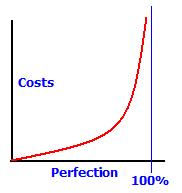 Personally, I’m a good enough guy. I have just one point here. Costs. Imagine a theoretical scale of perfection of software ranging from 0% to 100%. When you start your development you’re in 0% when you finish you’re somewhere in upper half of the scale. On the beginning improvements are easy. You invite first test UI which looks like it was designed by blind monkey. Then you have first iteration of target UI. It’s a huge improvement, probably a couple of dozens percents on the scale. However, when you’ve already made several iterations with UI and it looks decent the next would be probably making extensive usability testing. It’ll take much more effort than the first steps. Results will be probably much less significant. Few percent if you’re lucky. Next step? Maybe user feedback? You employ a number of people, who deal with all e-mails and phones from users, than trying to find a schema in all that mess, then verifying if accidentally some requests are not exactly opposite to others etc. More effort. More money. Results limited. Maybe another percent earned on the scale.
The example says about UI, but the rule is general. First performance optimizations will be fast and effective, unless you do them randomly. After some successes they’ll become harder and more costly. On the beginning of stabilization you’ll deal with big numbers of issues vastly improving stability of software. On the end the whole deployment will wait for a single bug fix. Of course that’s not a paradigm – there’re exceptions. Sometimes you can find some easy improvements even when you’re high on the scale, but it shouldn’t happen very often.
That’s why I’m a “good enough” believer. I don’t refuse to make small improvements, even when users can live without them. They’re welcome as far as they’re cheap. Great example was described by Basecamp team. Those changes are close to border separating good enough from better (hard to say on which side they are), but they were quick and cheap. And I guess the more important improvements were done earlier. If the changes were significantly more expensive I think 37signals would leave it as it was.
I believe that unless you have much time and money to spend you shouldn’t chase the ideal. There’re more important things to do.