

I’d love to get a beer each time I hear a story about management imposing a change on teams and facing strong resistance. Literally every time I’d fancy one, I’d be like, “Hey, tell me your agile transformation story.”
One common excuse is that people don’t like the change. That is surprising given how adaptable humankind has proven to be. I’d rather subscribe to the idea that people don’t mind the change; they don’t like being changed.
Unfortunately, being changed part is the story of oh so many improvement initiatives. And Agile implementations, obviously, are among the most prominent examples of these change programs, of course.
So, how is it really with responding to changes?
First, it really helps to understand typical patterns of introducing change. The model I find very relevant in this context is Virginia Satir’s Change Model. Let me walk you through it.
We start with the existing status quo, which translates to a performance level. We then introduce a new concept, which we call a foreign element.
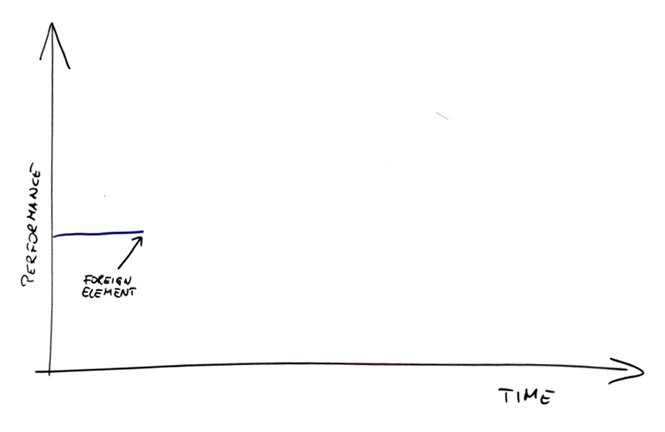
Then we observe an expected improvement, and they lived happily ever after and all. Well, not really. In fact, whenever I draw that part of the model and ask what happens next, people intuitively give pretty good answers.
After introducing a change, performance drops.
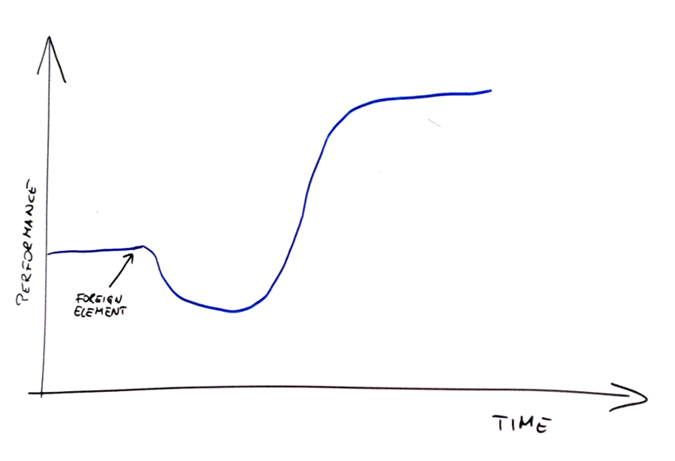
It is kind of obvious. We need time to learn how to handle a new tool, practice, or method. Eventually, we become increasingly proficient at whatever that is, and we start to see the results of the promised improvements. Finally, we internalize the change, and the cycle is finished.
Because of its shape, the curve is called a J-curve.
It is an idealized picture, though. In reality, it is never such a nice curve.
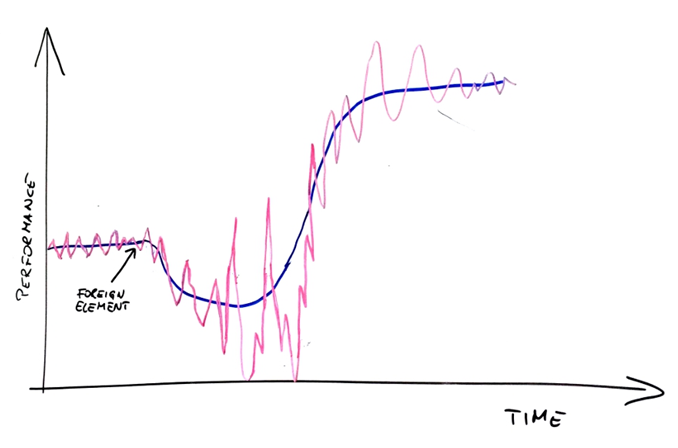
What we really see is something much bumpier. It isn’t a straight line to start with, when we maintain the old status quo. Then, it gets way more all over the place when we start messing with stuff. It’s not only that the rough average deteriorates, but also that the worst-case scenario gets worse, and by much more.
It’s pretty much chaos. In fact, that’s exactly how this phase is called in Virginia Satir’s original model.
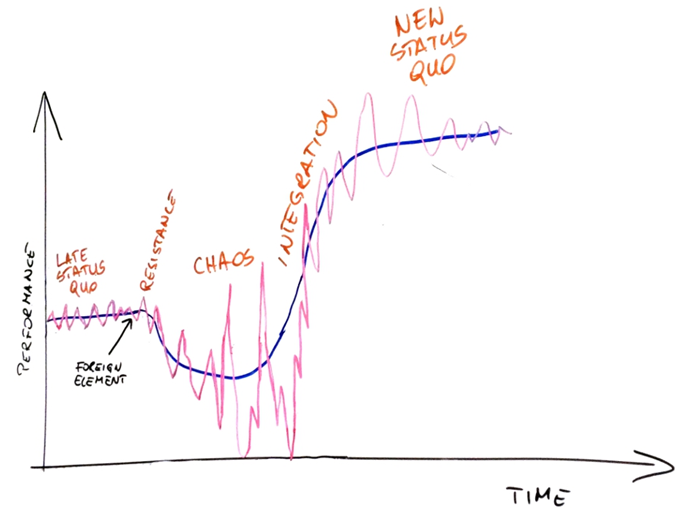
An interesting observation we can make is that the phase called resistance is a short one that occurs just after introducing a foreign element. Does it mean that we should expect resistance against the change to be short-lived?
Yes and no. Yes, if we consider only the “I’m not even going to try that new crap” type of resistance. This kind of reaction is typically driven by a lack of understanding of why the whole change was proposed in the first place. There is, however, a whole range of behaviors that happen later in the process that we would commonly call resistance as well.
Some people aren’t ready to see even a temporary drop in performance. Once they face it, they suggest a retreat to the old status quo. When facing a stressful situation, many people instinctively go back to what they know best. Unsurprisingly, the old way of doing things is precisely what they know best.
There are also those who are impatient and not willing to give people enough time to learn the ropes. Curiously enough, the last group often includes managers who initially funded the change.
In either case, the result is the same in the end. More resistance.
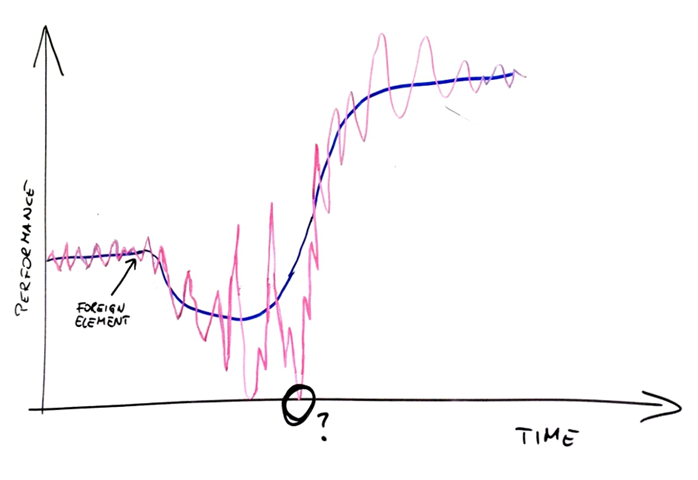
Inevitably, we reach a pivotal moment. We’ve been through the bumpy ride for quite some time already, and yet we haven’t gotten better. In fact, we’ve gotten worse. Not only that. We’ve gotten worse and less predictable. The whole change doesn’t seem like such a good idea after all.
So what do we do?
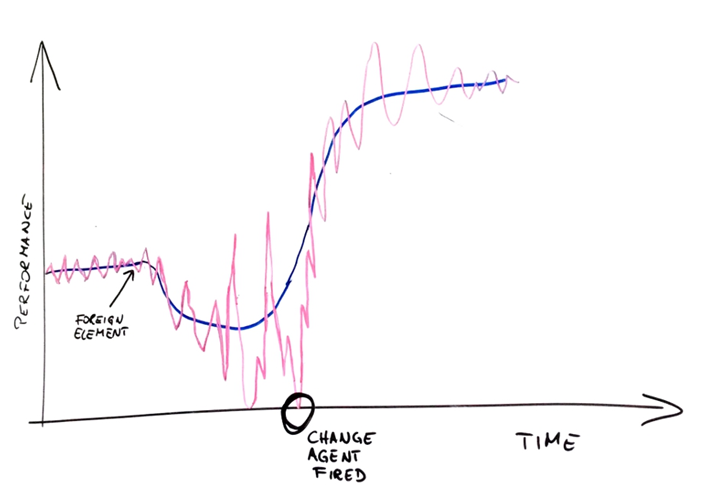
Of course, we reverse the change and go back to the old status quo. Oh, and we fire or at least demote that bastard who tricked us into starting the whole thing.
One interesting caveat of the whole process is that a change is not always simply reversible. When we change specific behaviors and yet don’t get the expected outcomes, reverting to the old status quo may be difficult, if not impossible.
For the sake of the discussion, let’s assume we are lucky and the change can be reversed. We are back to old ways of doing things, and we simply wasted some time trying something new. Oh, and we built a stronger case for resisting the next change. We petrified the existing situation just a little bit more.
One reason changes are often reverted is the perceived risk associated with them.
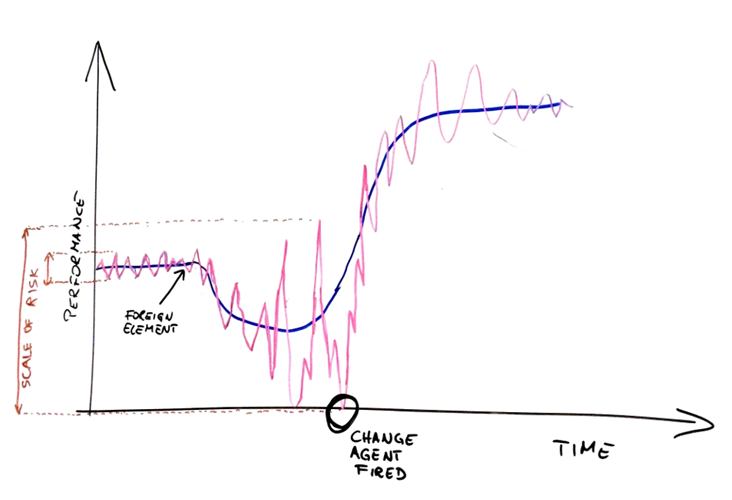
A pretty good proxy for perceived risk is predictability. Typically, the more unpredictable a team or process is, the riskier it is considered. In this case, the important thing that comes along with a foreign factor is how much predictability changes. Not only does performance drop, but it also becomes much less predictable.
While the former alone might have been bearable, the combination of both factors contributes to the perception that the change was wrong in the first place.
There is another dimension that is particularly interesting here. It is the scale of change. How much we change the existing environment: team, process, practices, etc.
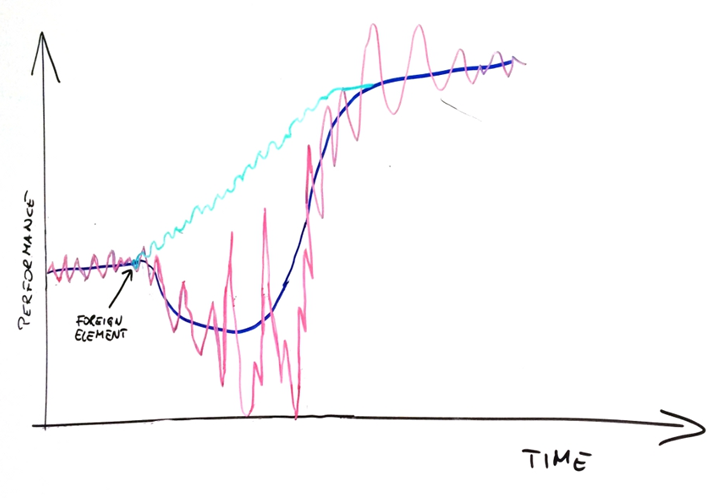
We can imagine a series of small improvements, each modifying the context only slightly. The entire series of them leads to a similar outcome as one big change rolled out at once.
We can describe one approach as evolutionary and the other as revolutionary. If we draw inspiration from Lean, we’d call them Kaizen and Kaikaku, respectively.
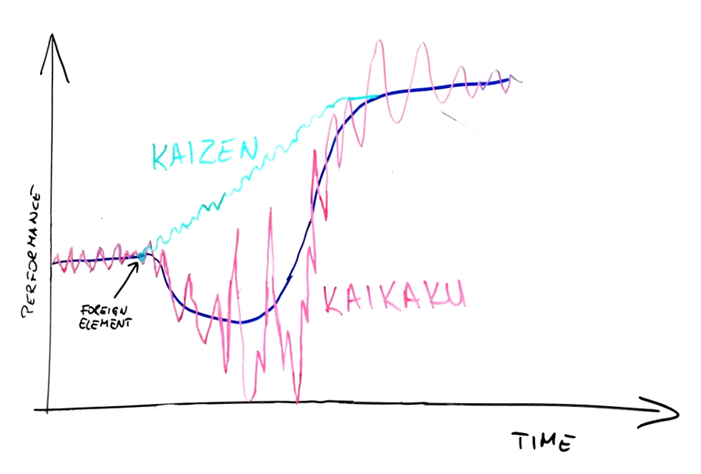
Fundamentally, the J-curve in both approaches would be shaped the same. The big difference is the scale. The revolutionary change means one big leap and rolling out all the new stuff simultaneously. This means a single big J-curve.
The evolutionary approach introduces a lot of tiny J-curves one after the other. In fact, it is possible to have a few changes run concurrently, but let’s not complicate the picture any more.
What are the implications?
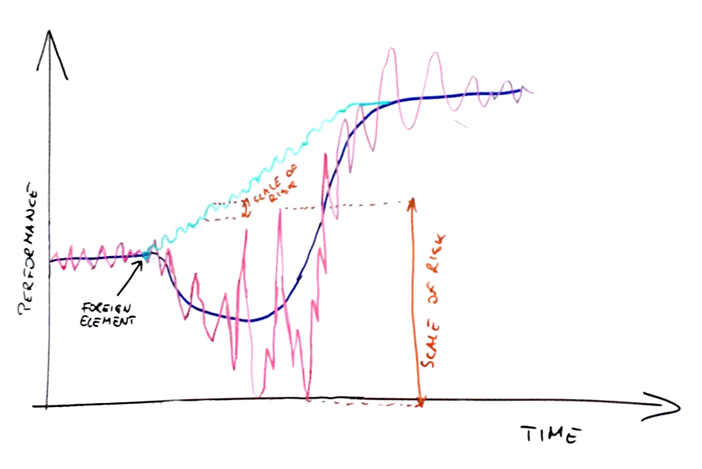
Let’s go back to the scale of the risk we undertake. With Kaikaku, the unpredictability we introduce is much higher than what we’ve seen in the late status quo.
Kaizen, on the other hand, typically suggests changes that are small enough to avoid destabilizing the system nearly as much. It is pretty likely that unpredictability introduced by each of the small changes will be almost invisible, given that we don’t deal with a fully predictable process anyway.
The risks we take with an evolutionary approach are much more acceptable than those we face when rolling out a single, large change.
That’s not all, though.
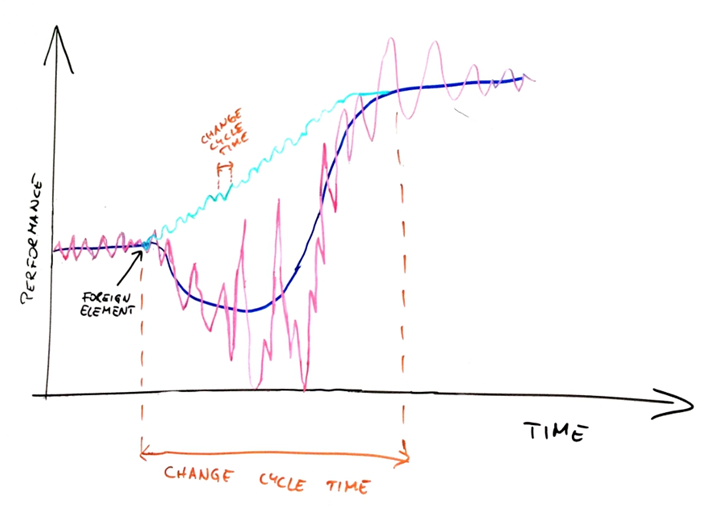
Another consideration is the duration of the destabilization. In other words, the cycle time of change.
A big change, naturally, has a much longer cycle time, as it requires people to internalize many more new behaviors, practices, techniques, etc. It means that exposure to the risks is longer. Given that the risks are also more significant, it raises the odds that the change will be reverted before we see its positive results.
With small changes, cycle time is shorter and so is exposure to risks. Again, not only are the risks much smaller, but they are also mitigated much faster.
One last thing worth mentioning here is that, so far, we optimistically assumed that all the proposed improvements have a positive outcome. That’s not true.
With the evolutionary approach, even if some of the changes don’t yield expected results, we still gain from introducing others. With a revolutionary approach, each part that doesn’t work simply increases the likelihood of reverting the whole thing altogether.
It is not to say that Kaizen is always superior to Kaikaku. Both evolutionary and revolutionary approaches have their place. We need Stuart Kauffman’s Fitness Landscape to explain that.
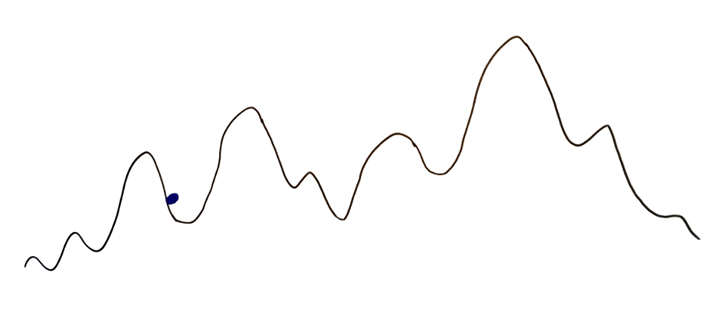
Imagine a landscape that roughly indicates how fit for purpose your organization is. It should simply translate to factors such as productivity, responsiveness to the changing business environment, etc. The higher you are, the better.
The simplest and safest way to climb up is to take small steps uphill.
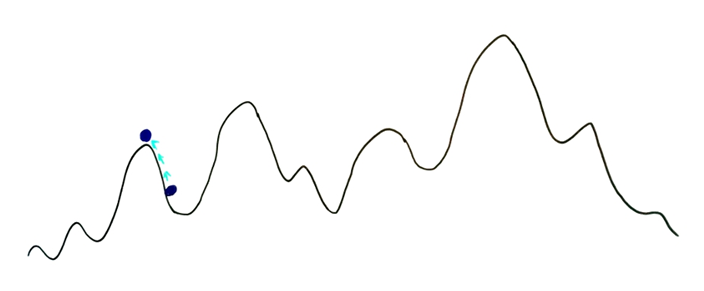
While the approach works very well, eventually we reach a local peak. If we continue our small steps in any direction, it would result in lower fitness for purpose. Simply said, we wouldn’t perform as well as we did at the peak.
If we look only at the closest terrain, we might as well say that we’re already perfect and there’s no need to go further.
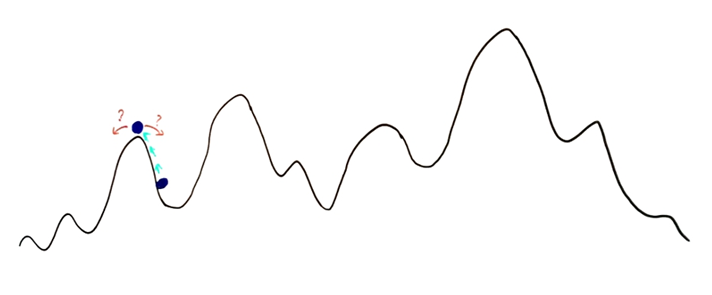
Obviously, that would be naive. Or stupid. Or both.
The solution becomes apparent when we take a broader view. If we moved to the slope of another hill, we could eventually reach even a better position.
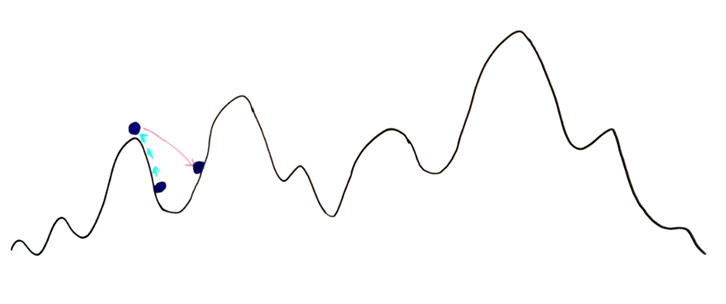
That’s exactly when we need a big jump. It doesn’t have to automatically land us in a better situation than the one we were initially in. The opposite would often be the case. What is important, though, is that we land on the hill that is higher. That translates to bigger potential for improvement.
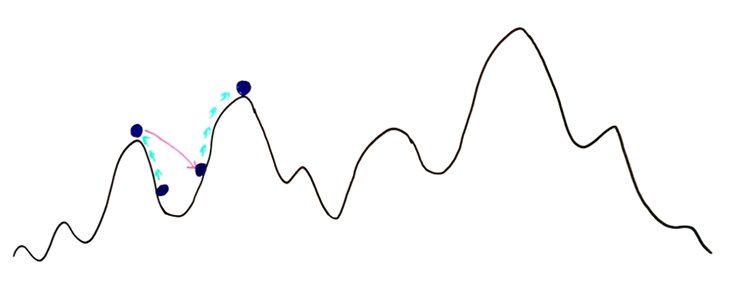
Once there, we can retreat back to the good old strategy of small steps that allow us to climb up. Eventually, we reach the peak that is higher than the previous one. Then we can repeat the cycle by looking for even a bigger hill.
Similarly, to the case of J-curves, the picture here is idealistic, suggesting that each change, whether small or large, is considered successful. In reality, it is more the result of experimentation. Some of the changes would work, while others would not.
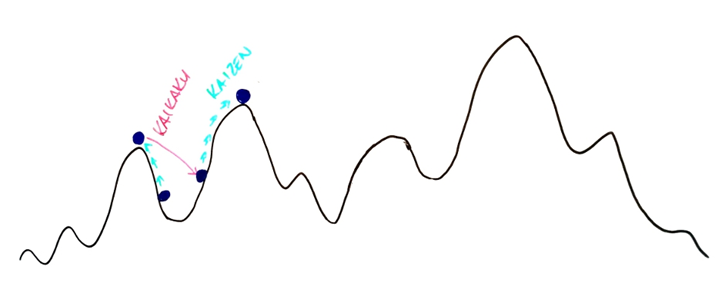
As you might have guessed, small steps here represent the evolutionary approach or Kaizen. A big jump is equivalent to revolutionary change or Kaikaku. Depending on the context, one or the other will be more useful.
In fact, there are situations when one of the strategies will be basically useless. That’s why introducing change without understanding the current context is simply begging for failure.
One more implication of the picture is that, given the lack of any other guidance, the evolutionary approach is both less risky and more likely to succeed. That’s why I prefer to start with Kaizen when I’m unsure about the context within which I’m operating.
One last remark on Fitness Landscape. What you’ve seen here is a heavily oversimplified view. In reality fitness landscape wouldn’t be two-dimensional. Stuart Kauffman discussed it as a three-dimensional model, although I tend to think of it as a multi-dimensional one.
It means that each change can improve our situation in some dimensions and have an opposite result in others (think: we’ve improved quality, but we are slower). We will have different combinations of effects in different dimensions—some more desirable and some less.
If that wasn’t enough, the entire landscape is dynamic and continually changes over time. In other words, even after reaching a local optimum, we will need further continuous improvements simply to maintain our fitness for purpose. The peak will be moving over time.
I know the post got long by now (thanks for bearing with me that far, by the way). This, however, is only a starting point for discussing why introducing the change often triggers resistance.
I believe it provides a pretty good explanation of why so many improvement initiatives fail. This is also one of my answers to the question of why many Agile adoptions are doomed to fail from day one.
Attempting to significantly change an organization without understanding its underlying mechanisms is simply begging for frustration and failure.
Finally, understanding the change models will influence the choice of the methods and tools we’d use to drive our change programs.
And if you chose a journey of a change agent, good luck! It can be as challenging as it can be rewarding.


