
Tag: hiring

  • Would You Pay to Have Your Resume Read?

    Would You Pay to Have Your Resume Read?

    As a job applicant, would you pay to make sure someone reads your application?

    Here’s a sad reality for many people applying for a job:

    • Their competitors (i.e., other candidates) use AI tools to mass apply.
    • As a result, hiring companies are flooded with applications, and sifting through all of them is impractical.
    • What follows is that hiring companies defer to other AI tools to filter out the vast majority of applications (often as much as 95%+).
    • The recruitment game becomes one of prompting one AI agent to pass through the filters of another AI agent.

    Realities of Job Seekers A.D. 2025

    Imagine that there is a job that you really want to get. It doesn’t even matter why. It may be because you know that the company is great, or the job profile matches your dreams perfectly, or you perceive the experience you’d get there as unique, or whatever. You just want in.

    But hey, since all those other people are using AI tools to spam the hiring company’s application form, your submission will disappear in that flood.

    It’s even worse than that. If you hand-craft your application to show your genuine care for the job, it’s almost certain that you’ll be rejected. After all, your original story will be written to a hiring manager (a human), but it’s never going to get there in the first place. It will be rejected by an automated AI tool (a bot) precisely because it’s non-conformist.

    Such a resume doesn’t match the most common patterns. There aren’t many similar examples in the AI model’s training data. It’s not common enough.

    If you want your application to get past the AI filter, you kinda have to play the game everyone else does. Optimize for what a bot wants. And it’s impractical to do it by hand. Just hire another AI agent to do it for you.

    Except that you’ve defeated the purpose that way. First, you aren’t more likely to get through. Second, even in the case that you do, the hiring manager will see another similar, bland-but-professional resume. You will not stand out.

    Most importantly, you will not carry over your care about that job.

    Recruitment in the AI Era Is Irrevocably Broken

    The story above neatly pictures how broken the recruitment has become. What’s more, there’s no going back.

    You can pretend it’s 2020 and send your manually-crafted CV, but you’re going to lose to people auto-submitting thousands of AI-generated resumes. Oh, and said resumes will be automatically tweaked to better match a job description, with no human effort whatsoever.

    A resume doesn’t work as a token of information exchanged between two humans (a hiring manager and a candidate) anymore.

    The career of a resume is over. At least the one that we know. If anything, a CV becomes a token exchanged between two AI agents, neither of which is programmed by the actual candidate.

    No matter how hard we try, there’s no coming back. We can’t make resumes unbroken again. Even if we aspirationally tried to restore the original meaning of a CV, there will always be a rogue player who will exploit that trust by mass-applying with generated stuff. And since that will give them a short-term advantage, others will follow suit.

    Winning the Game by Not Playing It Altogether

    It’s ironic how both sides of this equation—recruiters and candidates alike—are losing in the new setup. Candidates have it harder to show their care about specific jobs. Companies give up on the best matches because they employ a bot to reject 95% of applicants. And yet, no one can change the rules anymore.

    So, is conforming to the new state of things the only option?
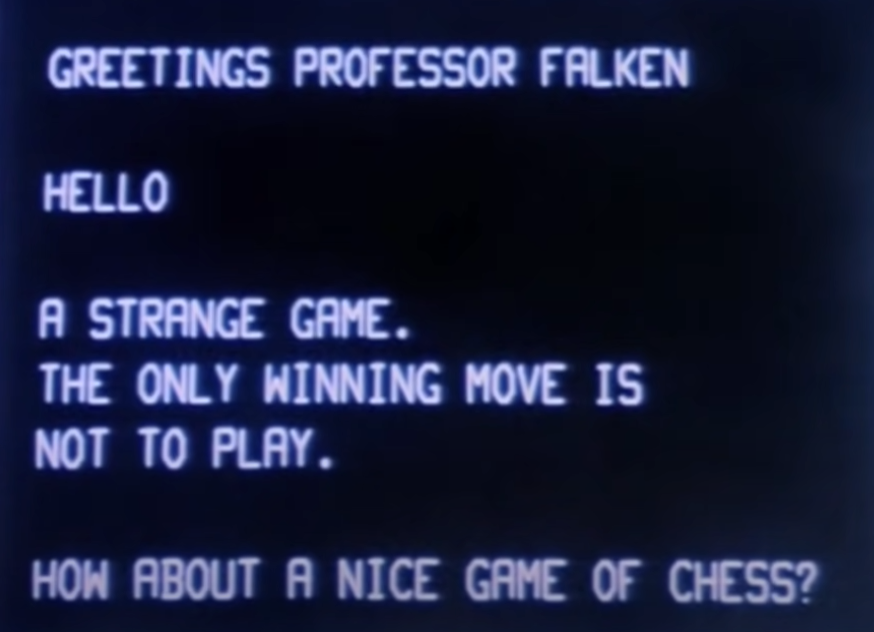
    wargames a strange game
    Image from the WarGames movie

    In the classic movie WarGames, the AI, which is trying to “win” the nuclear war, eventually learns that it always ends in mutual assured destruction. The only winning move, thus, is not to play at all.

    It’s the same with recruitment. If the current system forces us to mass-produce thousands and thousands of resumes that no one will ever read, we’re just adding noise to the system. The winning move? Not to play.

    But wait, if you want to change jobs, how are you supposed not to play the game? If you never apply, you never get that dream job of yours. Or a better one than you have now.

    Trust Networks as Antidote to AI Slop

    In recruitment, as much as in any other area, we will defer to trust networks to circumvent the noise. The more toxic AI slop is in the feed, the less we trust the feed altogether, and the more we rely on human-to-human connections.

    One side of relying on trust networks is that companies increasingly go for employee referrals rather than traditional open recruitment processes. That doesn’t solve the other part of the equation, though. What if I am a candidate and want that specific job?

    Do the same. Build a connection with someone at that company. We live in an interconnected world, and there are still places where a genuine message will stand out. They may attend local meetups, be active on LinkedIn, maybe publish a blog or a Substack, or engage in some other professional activities. If you care, you will figure that out. Get to know people first, and only then apply.

    Does it seem like a lot of effort? That’s precisely the point. It shows how much you care.

    Very recently, we made our first hire in almost two years. We didn’t even open a recruitment process. There was this guy who stayed in contact after we talked a few years back. And then, eventually, it was a good time for him and a good time for us. A win-win.

    The point is: he made the effort to reconnect. He made it easy for us to remember.

    This could only happen because we’ve built the human connection beforehand. We were two parts of the same trust network.

    Would You Pay To Put Your Resume at a Hiring Manager’s Desk?

    I admit, relying on trust networks is a lot of effort. And it takes time. Both would make the approach impractical at times. So what if there were a shortcut?

    That brings me back to my original question. As a candidate applying for a job, would you pay to skip the AI line? Would you pay to ensure that your application is read by a human?

    Note, your resume would still go through regular scrutiny. It’s just you’d know a human would do it, not a black-box AI agent.

    There’s an interesting balance here. Make it too cheap, say $0.02, and it changes nothing. People would still be mass-applying all the same, so no one would take that seriously. Make it too expensive, say $200, and it’s probably not a good return on investment for a candidate. After all, no one would hire such a candidate or even rate them any better. A hiring manager would just read and assess the resume as if it passed the AI filters.

    What’s in it for a candidate? It’s an open avenue to show genuine care. Since the applicant knows they’re not going through AI, they are free to optimize their application for a human reader. Hell, they actually are encouraged to go the extra mile with their application.

    What’s in it for a hiring company? I reckon it wouldn’t make sense for a candidate to pay for mass applying, so they’d do that only for jobs they actually care about. So the hiring company gets a token of care along with a resume. Recruiters can still assess skills the way they do, but before committing any effort in interviews, they clearly know which candidates consider the position a great match.

    So, would you pay to guarantee your resume is reviewed by a hiring manager? If so, how much?


    Here’s a little experiment that’s in the spirit of the post. This link here is a token of human effort behind the post.
    https://okhuman.com/CuC1uw

  • Trust Networks as Antidote to AI Slop

    Trust Networks as Antidote to AI Slop

    This week, AWS went down, along with a quarter of the internet. It’s funny how much we rely on cloud infrastructure even for services that should natively work offline.

    Postman and Eight Sleep failure during AWS outage

    That is, “funny” as long as you’re not a customer of said services trying to do something important to you. I know how frustrating it was when Grammarly stopped correcting my writing during the outage, even if it’s anything but a critical service to me.

    While AWS engineers were busy trying to get the services back online, the internet was busy mocking Amazon. Elon Musk’s tweet got turbo-popular, quickly getting several million pageviews and sparking buzz from Reddit to serious pundits.

    elon musk sharing fake tweet on aws outage

    Admittedly, it was spot on. No wonder it spread like wildfire. I got it as a meme, like an hour later, from a colleague. It would fit well with some of my snarky comments about AI, wouldn’t it?

    However, before joining the mocking crowd, I tried to look up the source.

    Don’t Trust Random Tweets

    Finding the article used as a screenshot was easy enough. It was a CNBC piece on Matt Garman. Except the title didn’t say anything about how much AI-generated code AWS pushes to production.

    Fair enough. Media are known to A/B test their titles to see which gets the most clicks. So I read the article, hoping to find a relevant reference. Nope. Nothing. Nil.

    The article, as the title clearly suggests, is about something completely different.

    I tried to google up the exact phrase. It returned only a Redit/X trail of the original “You don’t say” retort. Googling exact quotes from the CNBC article did return several links that republished the piece, but all used the original title, not the one from the smartass comment. It didn’t seem CNBC had been A/B testing the headline.

    By that point, I was like, compare these two pictures. Find five differences (the bottom one is the legitimate screenshot).

    matt garman fake and actual article
    Top picture from the tweet Elon Musk shared. Bottom from the actual CNBC article.

    So yes, jokes on you, jokers.

    Except no one cares, really. Everyone laughed, and few, if anyone, cared to check the source. Few, if anyone, cared to utter “sorry.”

    Trustworthiness as the New Currency

    I received Musk’s tweet as a meme from my colleagues. It went through at least two of them before landing in my Slack channel. They passed it with good intent. I mean, why would you double-check a screenshot from an article?

    It’s a friggin’ screenshot, after all.

    Except it’s not.

    This story showcases the challenge we’re facing in the AI era. We have to raise our guard regarding what we trust. We increasingly have to assume that whatever we receive is not genuine.

    It may be a meme, and we’ll have a laugh and move on. Whatever. It won’t hurt Matt Garman’s bonus. It won’t have a dent in Elon Musk’s trustworthiness (even if there were such a thing).

    It may be a resume, though. A business offer. A networking invitation, recommendation, technical article, website, etc. It’s just so easy to generate any of these.

    What’s more, a randomly chosen bit on the internet is already more likely to be AI-generated than created by a human. Statistically speaking, there’s a flip-of-a-coin chance that this article has been generated by an LLM.

    It wasn’t, no worries. Trust me.

    Well, if you know me, I probably didn’t need to ask you for a leap of faith in the originality of my writing. The reason is trustworthiness. That’s the currency we exchange here. You trust I wouldn’t throw AI slop at you.

    If you landed here from a random place on the internet, well, you can’t know. That is, unless you got here via a share from someone whom you trust (at least a bit) and you extend the courtesy.

    Trust in Business Dealings

    The same pattern works in any professional situation. And, sadly, it is as much affected by the AI-generated flood as blogs/newsletters/articles.

    When a company receives an application for an open position, it can’t know whether a candidate even applied for the job. It might have been an AI agent working on behalf of someone mass-applying to thousands of companies.

    While we’re still beating a dead horse of resume-based recruitment, it’s beyond recovery. Hiring wasn’t healthy to start with, but with AI, we utterly broke it.

    A way out? If someone you know (or someone known by someone you know) applies, you kinda trust it’s genuine. You will trust not only the act of applying but, most likely, extend it to the candidate’s self-assessment.

    Trust is a universal hack to work around the flood of AI slop.

    Outreach in a professional context? Same story. Cold outreach was broken before LLMs, but now we almost have to assume that it’s all AI agents hunting for gullible. But if someone you know made the connection, you’d listen.

    Networking? Same thing. You can’t know whether a comment, post, or networking request was written by a human or a bot. OK, sometimes it’s almost obvious, but there’s a huge gray zone. In someone you trust does the intro, though? A different game.

    linkedin exchange with ai bot

    The pattern is the same. Trust is like an antidote to all those things broken by AI slop.

    Don’t We Care About Quality?

    Let me get back to the stuff we read online for a moment. One argument that pops up in this context is that all we should care about is quality. It’s either good enough or not. If it is, why should we care who or what wrote it?

    Fair enough. As long as consuming a bit of content is all we care about.

    If I consider interacting with content in any way, it’s a different game.

    With AI capabilities, we can generate almost infinitely more writing, art, music, etc. than what humans create. Some of it will be good enough, sure. I mean, ultimately, most of what humans create is mediocre, too. The bar is not that high.

    There’s only one problem. We might have more stuff to consume, but we don’t have any more attention than we had.

    100x content 1x attention

    Now, the big question. Would you rather interact with a human or a bot? If the former, then you may want to optimize the choice of what you consume accordingly.

    Engageability of our creations will be an increasingly important factor. And it won’t be only a function of what kind of call to action a consumer feels after reading a piece, but also whether they trust there’s a human being on the other side.

    It’s trust, again.

    Trust Networks as the New Operating System

    Relying solely on what we personally trust would be impractical. There are only so many people I have met and learned to trust to a reasonable degree.

    Limiting my options to hiring only among them, reading only what they create, doing business only with them, etc., would be plain stupid. So how do we balance our necessarily limited trust circle with the realities of untrustworthiness boosted by AI capabilities?

    Elementary. Trust networks.

    If I trust Jose, and Jose trusts Martin, then I extend my trust to Martin. If our connection works and I learn that Martin trusts James, then I trust James, too. And then I extend that to James’ acquaintances, as well. And yes, that’s an actual trust chain that worked for me.

    By the same token, if you trust me with my writing, you can assume that I don’t link shit in my posts. Sure, I won’t guarantee that I have never ever linked anything AI-generated. Yet I check the links and definitely don’t share AI slop intentionally.

    If such a thing happened, it would have been like Musk’s “you don’t say” meme I received—passed by my colleagues with good intent.

    The degree to which such a trust network spans depends on how reliably a node has worked so far. A strong connection would reinforce its subnetwork, while a failing (no longer trustworthy) node would weaken its connections.

    strong and weak trust networks

    Strong nodes would allow further connections, while weak ones would atrophy. It is essentially a case of a fitness landscape.

    New Solutions Will Rely on Trust Networks

    The changes we’ve made to our landscape with AI are irreversible. In one discussion I’ve had, someone suggested a no-AI subinternet.

    It’s not feasible. Even if there were a way to reliably validate an internet user as a human (there isn’t), nothing would stop evil actors from copypasting AI slop semi-manually anyway.

    In other words, we will have to navigate this information dumpster for the time being. To do that, we will rely on our trust networks.

    Whatever new recruitment solution eventually emerges, it will employ extended trust networks. That’s what small business owners in a physical world already do. They reach out to their staff and acquaintances and ask whether they know anyone suitable for an open position.

    Content creation and consumption are already evolving toward increasingly closed connections (paywalled content, Substacks, etc.), where we consciously choose what we read and from whom. Oh, and of course, the publishing platforms actively push recommendation engines.

    Business connections? Same story. We will evolve to care even more about warm intros and in-person meetings.

    trust networks everywhere meme

    Eventually, large parts of the internet will be an irradiated area where bots create for bots, while we will be building shelters of trustworthiness, where genuine human connection will be the currency.

    Like hunters-gatherers. Like we did for millennia.

  • AI Has Broken Hiring

    AI Has Broken Hiring

    Late in 2023, at Lunar, we were preparing a recruitment process for software development internships (yup, we somehow hadn’t jumped on the “you don’t need inexperienced developers anymore” bandwagon). However, ChatGPT-generated job applications were already a concern.

    Historically, we asked for small code samples as part of job applications. The goal was to filter those who knew the basics from those who just aspired to become developers eventually. Granted, it wasn’t cheat-proof, but that wasn’t the goal.

    It was enough to tell the basics:

    • Was it more toward a naive solution or more toward the optimal end of scale?
    • Were there tests, and if so, what kind of them?
    • What about readability?

    Sure, you could ask a developer friend to write it down for you, but you’d eventually show a lack of competence at the later stages. Heck, we even had a candidate asking for a solution at a discussion group. But these were fairly rare cases.

    Recruitment in the AI Era

    So it’s late 2023, and we know the trick won’t work anymore. ChatGPT can generate a reasonable answer to any such challenge. Eventually, we decide against any coding task and simply ask to share a public GitHub repo. Little do we know, we’re way deeper in hiring in the AI era rabbit hole than we could have ever dreamed.

    Sure, we understand that people will feed ChatGPT with our job ad and have it generate output. After all, as always, we provide a great deal of context about what we want to see in the applications. That makes LLM’s job easier.

    We state explicitly that we seek genuine answers, and we’ll discard those blatantly generated with ChatGPT. Also, no LLM is an expert in who the candidate is, right? No LLM is an expert in me.

    We’re a small company. Till that point, our record was around 90 applications for the internships. Typically, it was maybe half of that. This time, we receive almost 600.

    Despite all our communication, most of them were generated by ChatGPT.

    AI as the First Filter

    OK, it’s no surprise. Instead of creating thoughtful and thorough answers to 4-5 questions, each taking at least a couple of paragraphs, now we can just feed an AI model of our choice, and it will produce as much text as anyone needs.

    Companies response? Let’s use the same models to tell which resumes we should even read. Otherwise, it’s just too many of them.

    ai in communicaiton

    And yes, in our case, I read each and every one of those 600 applications. Well, at least the parts. If the first paragraph has “AI-generated” painted all over it, and the question literally asked you not to generate your answers, then my job was done. I didn’t need to continue.

    By the way, the next time I will do the same. However, we are oddballs. It’s now the norm for the first filter to be an AI model that decides whether to pass an application on to a human being.

    In other words, the candidates generate applications with AI to pass through an AI filter.

    Do you see the irony?

    Just wait till someone starts putting hidden prompts in their resumes. Oh, wait, someone has definitely tried that already. I mean, if the researchers do that in a much more serious context, applicants trying their luck is an obvious bet.

    Hiring Noise

    Now, extrapolate that and ask: What does the endgame look like? More and more noise.

    Let’s just wait till we have AI agents that automatically apply to jobs on our behalf with no human action needed whatsoever. Oh, who am I fooling? There already are plenty of startups pursuing this path.

    jobcopilot website screenshot

    The promise is that you will be able to send hundreds of applications in one click. That’s great! You increase your chances! Or do you?

    Even if you do, it will only work for a very short time. Then everyone else will start doing the same, and suddenly every hiring company is flooded with tons upon tons of applications.

    What will they do? Yup, you guessed it. They’ll pay another AI startup to automate this job away. Most likely, they already have.

    We can easily increase the number of CVs flying over the internet by a factor of 10x or 100x. We still have only 1x of attention from hiring managers.

    The AI Era Hiring Game

    The early stages of recruitment will increasingly be like two AI models playing chess (while neither having an actual model of what a chess game is). One will try to outplay the other.

    An agent playing on a candidate’s behalf will try to write an application that will pass the filters of a hiring company’s agent. The latter, in turn, will attempt to filter out as many applications as possible while still keeping a few relevant ones.

    Funnily enough, I’m guessing that what will make you pass through the AI filter will not necessarily be the same things that would make you pass when a human being reads your resume.

    LLMs optimize for the most likely output. So “standing out” isn’t necessarily the optimal strategy.

    I remember when an applicant drew a comic book for us as their application. It sure caught our attention. I bet an AI model would dismiss it. Oh, and yes, she ended up being a fabulous candidate, and we hired her.

    Which doesn’t mean drawing a comic book guarantees you a job at Lunar, of course.

    If we were to believe startups operating in the recruitment niche, these days, hiring is just a game of volume. Send and/or process more resumes, and you’ll find your perfect match.

    What Is a Perfect Match?

    I’ve been recruiting for more than two decades. I’ve made my share of great hires. I’ve made a lot of mistakes, too. Most importantly, though, I’ve made oh, so many good enough hires who have ultimately turned out to be excellent later on.

    It doesn’t matter how extensive your hiring procedures are. After a week of close collaboration, you will know about the new hire more than you could have learned throughout the whole recruitment process.

    Applying for a job is like submitting an abstract for a conference’s call for proposals. A great talk description doesn’t mean that the session itself will be great. It just means it is a good abstract. And that the person who submitted it is probably good at writing abstracts. It tells little about what kind of speaker they are.

    By the same token, a great resume is just that. A great resume.

    What we’re doing in recruitment with AI is we set almost the whole limelight on the applications. It becomes a game of writing and analyzing CVs.

    Last time I checked, no company was trying to find a person who was great at writing resumes (or more precisely: getting an AI model to generate a resume that another AI model would like).

    Renaissance of Good Old Coding Interviews

    It’s no surprise that physical coding interviews are gaining popularity again. Increasingly, using the AI tooling of choice will be allowed and encouraged during those. Ultimately, that’s how developers work every day.

    After all, these interactions were never about knowing the answer. OK, they should never have been about the answer. They should have been about how a candidate thinks, iterates their way to a better solution, and when they deem it good enough. They should have been about working together with another professional. About all those intangibles that we don’t see unless we have an actual experience of working together.

    We will see more of those. And there will be more of those happening on-site, not remotely. As a hiring person, I want to understand what part of someone’s train of thought is their creativity and what came as copypasta from ChatGPT (or Claude Code, or whatever).

    There’s no shortage of code-generation capabilities. We still don’t have a substitute for judgment, though.

    Why Is Hiring Broken?

    So far, so good, you could say. We return to proven tools and focus on what really matters.

    Yup. That is as long as we’ve cut through the noise. Next time we open internships at Lunar (and we will), I expect more than a thousand applications. Sure, many will be crap, but there will be plenty of work to figure out which will not. The effort needed to navigate the noise grows exponentially.

    Under the banner of “we are improving recruitment,” we actually did a disservice to both parties that play the hiring game. Candidates complain that they send lots and lots of resumes, and they don’t even get any responses anymore. Hiring companies have to deal with a snowballing wave of applications, which means that finding a great match is nearly impossible.

    That much for good intentions and improvements.

    All it took was to remove the effort required to prepare an individual job application. The marginal cost of thinking of and typing those five answers in a form is gone, and thus we can spray our resumes everywhere with one click of a mouse.

    Thank you, AI, for breaking the hiring for us.

    (And yes, I know it’s all us, not AI.)

  • Cultural Fit versus Cultural Fit

    There is a remark on hiring I’ve heard quite a few times recently. It’s about sending a rejection message to a candidate. It goes along the lines: “Just don’t tell them that they’re not a good fit for the culture. That’s bullshit. That means nothing.”

    A Bad Fit

    I can’t say that such a remark lands well with me. I do, however, understand where it is coming from. As the industry, we started paying attention to the culture. It’s on our radars. We may have only a vague understanding of what organizational culture is but it is already a part of the discourse. This vagueness of understanding of the concept actually comes handy when there’s no tangible reason to reject a candidate but we still somehow didn’t like them.

    They are a bad cultural fit.

    Whatever that means.

    See, the problem I have with many of these statements is that they’re used as a bludgeon without much thought invested to why “we didn’t like” a candidate. Because of that we often throw the baby out with the bathwater.

    A Good Fit versus Likability

    When hearing about lack of cultural fit I often follow up ask what it means that a candidate wasn’t a good cultural match. The answer, most often, is something like “that’s a person we wouldn’t get on well with”, or “that’s not a person I’d like to hang out with”, or “it’s not my kind of a person”. These boil down to how likable a candidate is for an assessing person.

    The problem is that likability is a terrible way of assessing cultural fit. Not only is it not helpful, but it is also counterproductive.

    If we chose likability as our guiding principle to judge cultural match we would end up with a group of people similar to each other. They’d have similar interests, many shared views and beliefs, etc. We would be building a very homogeneous culture. An echo chamber.

    Sure, there wouldn’t be much conflict in such a group. There wouldn’t be much creative thinking either. There would be premature convergence of the ideas, little scrutiny, few alternative options would be explored.

    If we consider knowledge workers such a team would have appalling performance. Thus my problem with such a shallow understanding of cultural fit.

    Shared Values, Diverse Perspectives

    So what is an alternative? How to define cultural fit in a way that would yield a high performing team? General guidance would be to optimize for representation of different, diverse points of view while creating an environment where people are encouraged to contribute.

    These two ingredients—diversity and enabling environment—balance each other in a way.

    We want diversity to have an option to learn about other, non-obvious ideas. Such ideas won’t come from people similar to ourselves. We thus want to have a range of different people in a team. And when I say “different”, I think of different walks of life, different experiences, different beliefs, different preferences, different characters, etc. This might be translated to maximizing diversity.

    However, diversity for the diversity sake is not the way to go. This is exactly where the second part kicks in. We want to sustain an environment where people share their diverse opinions, and not simply have them. For that to happen we need to have a common base that encourages people to feel comfortable enough to contribute.

    That common base is a set of shared values. I won’t give you a list as I don’t believe there’s the way. There are many ways to build such an enabling environment. There are, of course, usual suspects: respect for people, emotional safety, or autonomy, just to mention few. The important part is that such a set of shared values provides an informal, and typically implicit, contract that makes it safe to contribute.

    Cultural Fit

    With that founding principle, the definition of a cultural fit would be very different. A good match would mean that we share core values but beyond that, a candidate is as different from current team members as possible.

    This means that friction will happen. Conflict too. Not everyone will feel comfortable all the time and not everyone will be getting on well with everyone else.

    This means that when we decide there isn’t a good fit we may come up with a much more tangible explanation why. It is because we don’t share values—e.g. we perceive a candidate as disrespectful—or we don’t sense any aspect in which a candidate would stretch diversity of the team in one of the desired dimensions.

    Note: not all dimensions of diversity are equal. There’s little, if any, value in my experience as a sailor in the context of product development. There’s more value in, say, cognitive studies that someone else went through. That’s why I add a quantifier “in the desired dimension” next to “diversity”.

    Some time ago at Lunar Logic, we rejected a candidate for a software developer role whose focus was purely on their technical skills. There’s nothing wrong in that of course unless this is the only dimension a candidate uses to look at themselves and at others. There was some mismatch in shared values, e.g. little understanding and appreciation for teamwork and collaboration. We didn’t see much diversity that they would add to the mix either—we already have quite a bunch of excellent developers.

    Interestingly, the decision was made despite the fact that we liked the candidate and were getting on well with them. That’s a complete opposite of what a naive approach to cultural fit would suggest us to do.

    We believe that we are better off with that decision. More importantly, we believe that the candidate will be better off too. As long as they find a company where there’s a better overlap in shared values not will they contribute more but will also be appreciated better.

  • Emergent Purpose

    There are those presentations at conferences that stay with us for a long time, even if there seems to be no particular reason for that. And yet they keep coming back for one reason or another. One of such presentations for me was a discussion between Arne Roock and Simon Marcus from Lean Kanban Central Europe years back.

    Even though the topic of the discussion was broader there is one context that keeps coming back to me. Autonomy and alignment. A recurring theme was that we can’t enable autonomy unless we have alignment around a strategy, a goal, or whatever is the thing that orchestrates individual efforts.

    As Peter Senge in his classic The Fifth Discipline puts it:

    To empower people in an unaligned organization can be counterproductive.

    It obviously makes sense. I mean, distributing autonomy is all fine but also creates a risk that everyone would pull an organization toward a different direction. Alignment, which goes through understanding of a common goal, helps up to focus on rowing in the same direction.

    At the same time, watching the session back then, I couldn’t help but thinking that we at Lunar Logic hadn’t been doing that. We’d been continuously distributing more and more autonomy to everyone and at the same time there hadn’t been any official strategic purpose set for the organization for quite some time.

    It the spirit of the discussion between Arne and Simon, who I both respect a lot, that should feel wrong. And yet it didn’t.

    I could even remember my earlier discussions with Jabe Bloom. Jabe was pointing how important were techniques he adopted to help people connect their everyday behaviors with strategic goals.

    Nonetheless, I still felt like imposing a strategy onto Lunar Logic would be a bad move.

    It was months later when I came across the concept of emergent purpose. In its spirit it’s all about understanding organizational culture. It starts with an assumption that everyone at an organization has their individual purpose and it is only natural to pursue that individual purpose. It means that, given no other guidance, everyone would work toward achieving their own personal goals. Some people would have goals similar to others. Some would have very distinct aspirations. Some would have much stronger drive to achieve their own goals than other who would be fine going with the tide.

    If we tried to visualize that as forces pulling an organization in different directions it might have looked like this.

    emergent purpose

    As a matter of fact it would also mean that there is an aggregated force pulling the organization in some direction. And that aggregated force is exactly an emergent purpose.

    emergent purpose

    By its design we don’t set an emergent purpose. It’s simply the outcome of individual purposes. It also means that for some people in an organization the emergent purpose may be the exact opposite of what they individually want. That’s all fine.

    Despite the fact that it’s an emergent property of any organization, we have means to influence the emergent purpose. It happens through hiring. When someone leaves an organization their influence on emergent purpose disappears. At the same the organization hires someone new whose expectations may be better aligned with the emergent purpose.

    emergent purpose

    Through such a change the emergent purpose has been amplified.

    There is interesting dynamics in that process. If my own goals are aligned with the purpose of the organization I’m with, it is less likely that I’d leave the organization than if it was otherwise. And corollary to that, my chance of being hired and wanting to join an organization is higher if there is alignment in place.

    In other words emergent purpose tends to sustain and even amplify itself, even with no conscious effort from leaders of an organization.

    The final, and most important bit about the idea of emergent purpose is that every organization has an emergent purpose. It doesn’t matter whether they have an official strategic purpose or not, or how strong it is, or whether there is alignment between a strategy and an emergent purpose. It’s always there, as the only way to get rid of it would be to make people stop having any ambitions, which is an equivalent of not having any people in an organization, I guess.

    That’s exactly where the fun starts. Given that there always is an emergent purpose, we’d be dumb not to listen to it. Now, I don’t say we necessarily need to pursue it actively, yet understanding it is crucial.

    The reason is that whatever strategy we choose there will likely be a gap between that strategy and the emergent purpose. The bigger the gap the more people would get disengaged and likely eventually leave. From that perspective there is a price to pay for any strategy and, simply put, the better we understand the emergent purpose the better we are suited to achieve our strategic goal. Also, in simple economic terms, there may be strategies that simply are too costly to pursue.

    Ideally, you can do what we did at Lunar Logic. We basically turned our emergent purpose to a company strategy. Instead of imposing a strategy on everyone we listened to each other and figured what’s the most desired path we want to pursue for the time being. That’s how we evolved our aspiration from helping to build products for our customers efficiently to helping the customers to succeed with their products. The latter isn’t focused on the building part nearly as much as the former.

    Interestingly enough, out of the potential strategies that we discussed there was one which would make me leave the company eventually. Luckily for me it didn’t end up being our emergent purpose after all.

    Of course I understand that few companies would go as far as we did. Even though I think it is an awesome idea I don’t encourage organizations to make that bold move. Nevertheless, knowing what the gap between aspirations of leaders of a company and everyone else is crucial if we look for any reasonable level of sustainability.

    Finally, emergent purpose is also one of possible answers for autonomy and alignment issue. As long as we understand what an emergent purpose is we can decide to stick with it or just slightly shape it instead of building alignment externally through officially set strategic goals.