
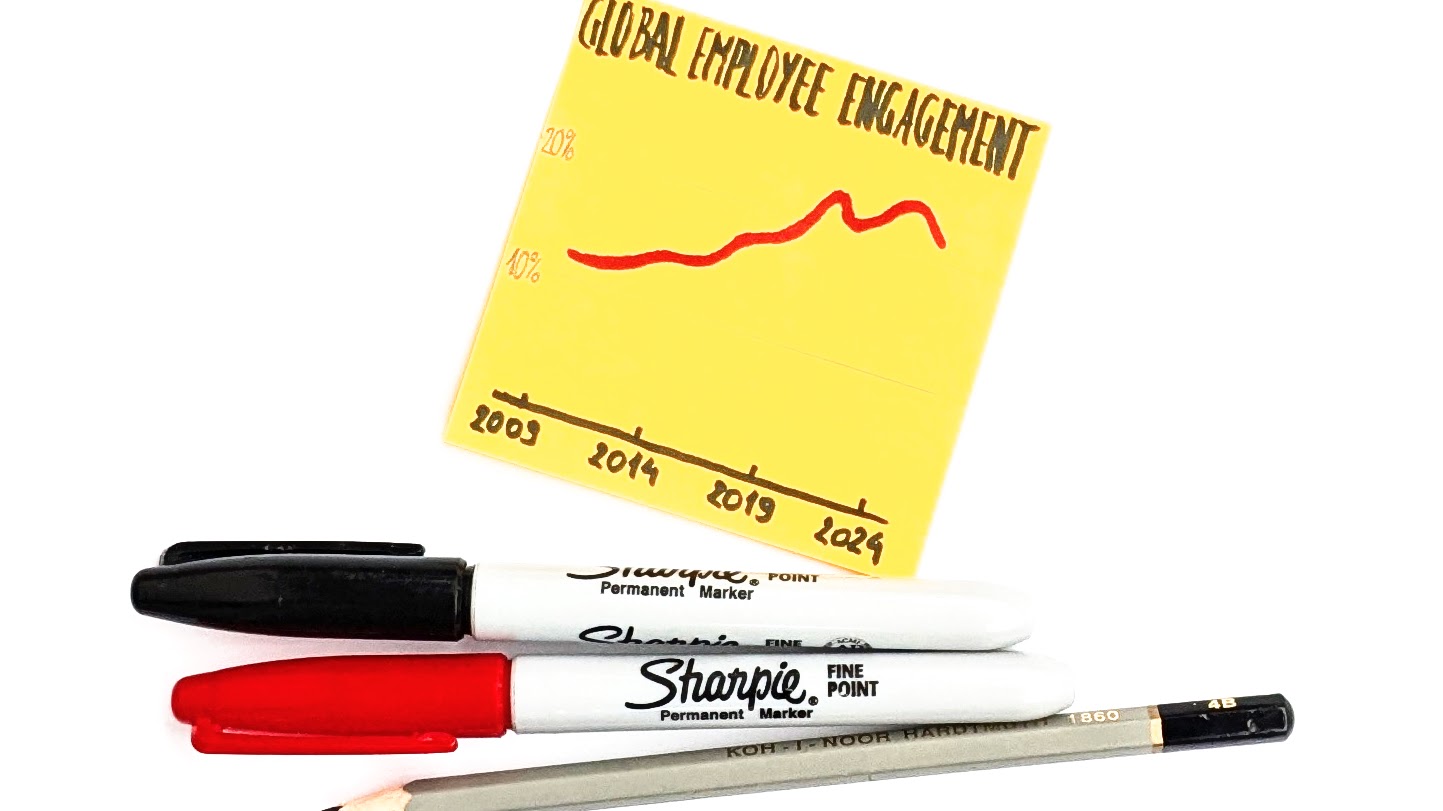
I like the following quote from Gallup’s State of the Workplace. It’s from the 2023 report, but it didn’t lose any relevance.
After dropping in 2020 during the pandemic, employee engagement is on the rise again, reaching a record-high 23%.
Yup, it reached a record high in 2022, stayed there in 2023, and dropped again in 2024.

We had COVID-related uncertainty to blame for the drop last time. This time it’s AI-related uncertainty. Here’s a thing, though. We discuss marginal changes. A per cent here, a per cent there.
The big lesson remains the same. Engagement levels in the modern workplace are appalling.
If it were a football team (a soccer team for my American readers), it would be as if 2 players tried to win, 7 just moved around without much engagement, and 2 more tried to score an own goal. If you’d rather take a basketball metaphor, you get one baller who tries to win, 3 who fake defense, and one who keeps turning the ball over to the other team.
The only hope of actually winning is that the other team is about as disengaged as yours.
These are realities we have lived with in the past decade. Before that, it was even worse.
Autonomy, Mastery, Purpose
So why is the engagement so low? I like Dan Pink’s answer. In his classic book Drive (and no less classic TED talk: The puzzle of motivation), he points 3 prerequisites for high motivation.
- Autonomy. The ability to decide about important aspects of the work we’re doing.
- Mastery. Being able to work according to our own aspirational quality standards and get better at what we do.
- Purpose. Having a shared goal with a broader team or group, we collaborate with.
Remove either, and you remove the conditions for engagement. Since we have a motivation gap, at least one part of the trio must be the culprit.
Purpose tends to be relatively individual for companies. You can probably instantly think of organizations that are purposeless (take any that have “increasing value for shareholders” painted all over the place) as well as those that are purposeful.
Mastery is trickier. However, in the context of knowledge work, I see a one-way correlation between autonomy and mastery. If you can make all relevant decisions about how you work, you very likely can work according to the aspirational standards you set for yourself. If you have autonomy, you can have mastery, too. The vice versa is not necessarily true.
So yes, when I have to explain Gallup’s results, I blame autonomy, or rather, lack thereof.
Hierarchy Discourages Autonomy Distribution
In a modern corporation, we perceive hierarchy as the only possible organizational paradigm. Hierarchy here is understood as a decision-making power distribution structure. The higher up you are in a hierarchy, the more (and more important) decisions you can make.
Sadly, that very structure discourages us from distributing autonomy to lower levels. If I hypothetically allowed my team to make the decisions assigned to me, inevitably, I’ll face a situation where someone makes a decision I disagree with. Then I face two choices, both bad.
I can stick with the decision that goes against my experience, intuition, and better judgment. However, since it was mine to make, I’ll be responsible for its outcomes. If my experience, intuition, and judgment were any good, I would pay the consequences of a mistake, even though I knew it was a wrong call in the first place. Psychologically, it’s a tall order.
The other option is to change the decision. In one swift move, I fix the decision and show my team that they didn’t have any autonomy in the first place. They could “make” decisions only as long as these were decisions I would have made anyway. If that sounds like a kick in the teeth, it’s because it is.
Hierarchy discourages managers from distributing autonomy. Add to that how prevalent this organizational model is, and we have an answer to why engagement in the modern workplace sucks big time.
The Writing Is On the Wall
No matter which vantage point we choose, we see the same picture.
- We cheer appalling engagement levels only because they’re slightly better than they were.
- We listen to Dan Pink’s rants with awe, then go back to the same old solutions that never worked.
- We applaud stories of bold leaders who challenged the status quo with stunning results, and rationalize them, saying, “It would have never worked in my company.”
I’m curious, how well your current “solutions” work? If we believe Gallup data, there isn’t much to brag about. On the one side, we have unquestioned dogma, which we have followed for more than a century. On the other, we have science. In such cases, I tend to pick team science.
This is Dan Pink again:
“This is one of the most robust findings in social science, and also one of the most ignored.”
“There is a mismatch between what science knows and what business does.”
The writing is all over the wall. And it will only get more pronounced as we surrender parts of our autonomy to AI agents. Let’s not expect fundamental changes in our motivation levels.
Unless we start treating the autonomy gap seriously, that is.
This is part of a short series of essays on autonomy and how it relates to other aspects of the modern workplace. Published so far:
- Pivotal Role of Distributed Autonomy
- Role of Alignment
- Care Matters, or How To Distribute Autonomy and Not Break Things in the Process
- What LEGO Can Teach Us about Autonomy and Engagement
This post has been human-created: 웃https://okhuman.com/g8lX5w
Leave a Reply