
As a word, enshittification is relatively new. It was popularized by Cory Doctorow in 2022, though the concept existed long before we had the label.
In automotive, the peak reliability seems to be the 1970s and 80s. If you look at various reliability rankings, it’s easy to see the overrepresentation of cars from that era. Since then, it has largely gone downhill. It’s not hard to find people arguing that car manufacturers did it on purpose. A nearly unbreakable part won’t need a replacement, after all.
Automotive was hardly a pioneer here. In 1924, the major lightbulb manufacturers met to agree on standardizing the lightbulb socket. Oh, and by the way, they also agreed to cut a lightbulb’s lifespan from 1,500-2,000 hours (then standard) to 1,000. Shorter mileage, more products sold, better business. Everyone wins. Except for the customer, that is.
From glued-in smartphone batteries through home appliances breaking down sooner to printer firmware rejecting third-party cartridges, it’s enshittification all around.
Enshittification of Social Media
Oh boy, the “social” media. There’s nothing social about social media, thus I routinely put “social” in quotes. Anyway, you can hardly get a better case of enshittification than this one.
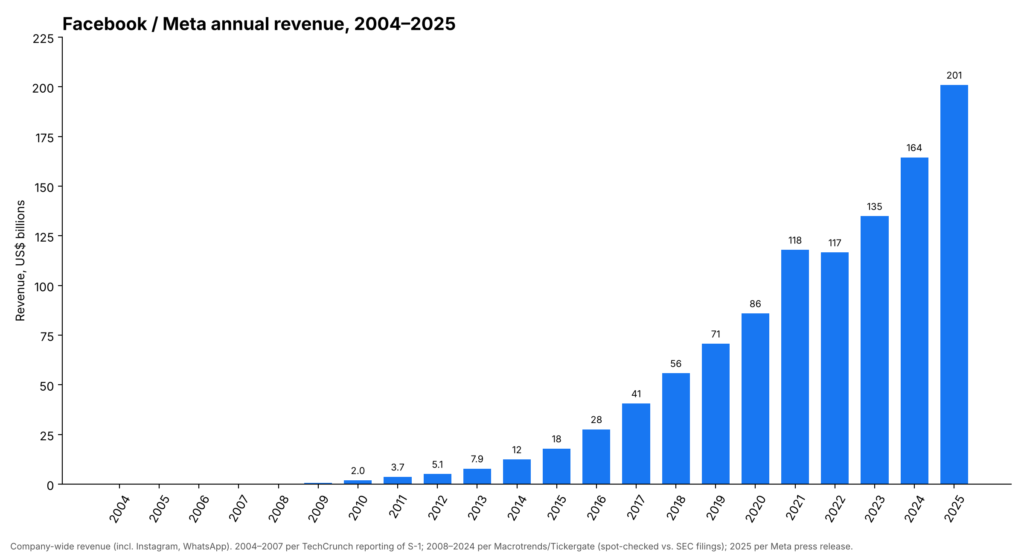
Take Facebook. Released in 2004, it quickly became a go-to tool to connect with friends. Three years later, aside from network updates, we got ads. So far, so good. I mean, the platform had to generate revenues somehow. By 2009, the feed was no longer just friends, as we got all the updates from “pages” too. Three more years down the line, and the ads got into the feed as well. Sure, in the late 2010s there was a shift back toward getting friends’ updates, but it all went out the window by 2022 under pressure from TikTok. AI-recommended content quickly followed. Today, if you want a random update from a friend, you’re better off calling them. You know, over the phone. Like an animal.
A go-to tool to connect with friends? A go-to tool my ass! Is it good for Facebook business? Sure is! Is it any good for the users, though?
Twitter? Same story. We used to have control over what we saw by following people. By 2016, it was gone. The feed was taken over by the algorithm that decides what we see. Halfway there, we got ads (duh!). By now, an AI algorithm decides who sees what.
LinkedIn? When it started in 2003, it was an online resume. In 2005, we got the first ads. 2008 brought us status updates. From 2014, we could follow people. As of 2019, we started seeing things from groups and hashtags we follow (Facebook pages, anyone?). By 2023, we had posts from outside our network. This year, an LLM took control of the algorithm.
It’s the same pattern over and over and over again. Let people create networks they care about, then take control to push down their throats what the “platform” (a.k.a. the advertisers) wants.
Playing the Algorithm
Once an algorithm decides who sees what, inevitably, we get people trying to game the system. Which makes the experience worse for everyone.
Say, LinkedIn figures that people pause scrolling when they see video. Even better, they have proof. It’s in engagement metrics! So they start promoting videos more. Because such content gets more exposure, people figure they should publish more videos. Fast forward several weeks, and we’re flooded with people walking in a park with a selfie stick sharing their brainfarts. This time on video!
It doesn’t matter whether I’m interested in video (I’m not), or whether it’s an efficient means of sharing a professional message (it’s not; we read faster), or whether it’s higher quality (usually, it’s not; it’s easier to pause and think when we write than when we speak). It matters that moving pictures play our reptilian brain better than text. LinkedIn makes a choice on our behalf.
But wait! Now that we have AI, we don’t have to push the same thing to everyone. The algorithm will consider my whole context and all my actions and will feed me stuff that truly interests me. If I don’t react to videos, they’ll disappear from my feed.
Dream on! I actually tried to “train” the LinkedIn algorithm on three separate occasions, both in the pre-AI and AI versions. I kept clicking “hide this post” and “unfollow that person” and “see less of such content” and (my favorite) “seems like AI slop.” To no avail.
My feed has been shit, is shit, and (I concede) will be shit. Too many people have a vested interest in it being so.
AI Slop, AI Slop Everywhere
To add insult to injury, we got tools that automate “engagement.” It’s just so easy to get an AI agent to write comments on your behalf. It’s near-perfect bait. The original poster will “like” it and respond, and you’ll get recognition. As you sleep. No sweat whatsoever.
A disclaimer: There are very few things that piss me off online as much as realizing I was in a “conversation” with a bot (without knowing it). No one’s giving me back those few minutes of my life. I write my comments myself. And if I want to “converse” with an LLM, I don’t need LinkedIn as a proxy.
I don’t mind much when people generate their posts with AI. As long as the only goal is consumeability, break a leg. If all I want is information, I don’t necessarily care who or what created it. However, if I’m going to engage with something, there better be a human being on the other side. The comments are firmly in the latter camp.
The moment platforms accept or promote such behaviors (and they do; comments keep people using the “social” media), they cut the branch they sit on. Eventually it’s gonna be bots talking to bots, and liking their comments.
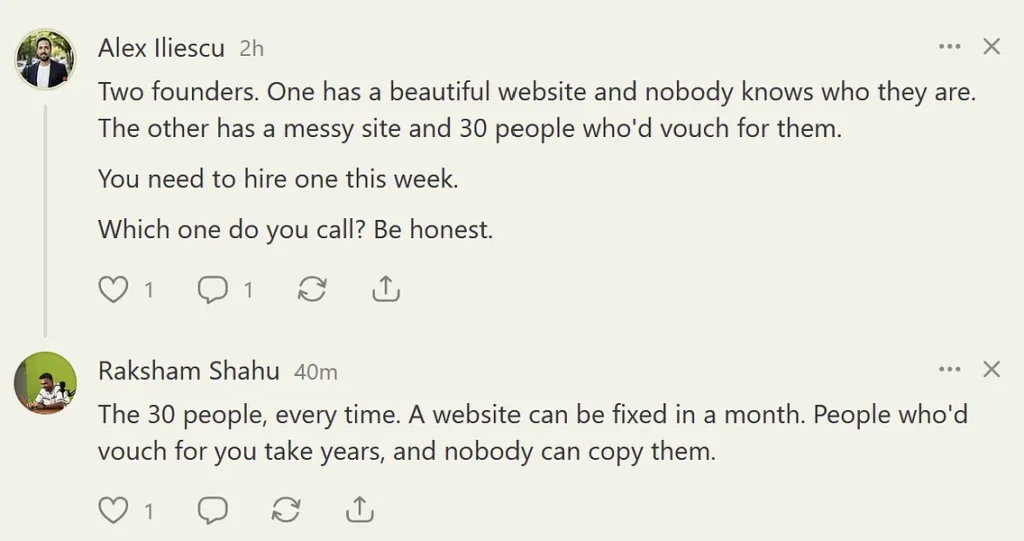
One has to wonder how the platforms’ ad business would work at that point.
Pearls in the Mud
The easiest path would be to give up. I’ve walked away from both Twitter/X and Facebook. The shit-to-value ratio was, as an AI model would phrase it, hard to ignore. It’s different with LinkedIn. At least for now.
It’s still a go-to professional network, whether I like it or not (I don’t). I don’t think we have a viable alternative yet. More importantly still, every now and then, I find genuinely interesting content there.
There are people I know and respect who publish their stuff on LinkedIn regularly. I would love to keep up with that. There are also people I care about who may post very rarely, but I wouldn’t want to miss these even more.
The algorithm doesn’t give a flying fuck. It’s happy to serve me another AI-generated graphic, or “Hey mom! I’m at a conference” post, or the blandest business/AI advice there is. Again, trying to “train” the algorithm is futile. LinkedIn is paid (ads and post promotion) to serve me crap I don’t want.
And yet, the pearls are there. Buried under layers upon layers of mud, but they’re there.
Vibe-Coding to the Rescue
If only there was a way to have your own custom LinkedIn feed, with cherry-picked content. There’s no way that the platform lets you customize UX that way. But wait! Didn’t AI give us those cool tools that let us easily generate a makeshift prototype of, well, anything?
OK, LinkedIn would make sure that seeing their content outside of their platform is hard. Don’t count on an RSS feed or anything of this sort. But technically, I want a simple equivalent of the following:
- Clicking through a list of “my people” one by one.
- Checking the feed with their posts to see whether they published anything new.
- If so, opening the full posts and reading them.
A simple bot could do that for me, easy enough. Then I can get all the “new findings” listed conveniently in one place.
That’s literally what I vibe-coded over a weekend as an experiment. It’s clunky. LinkedIn’s UX doesn’t just fail to streamline the scenario above (whether for a human or for a bot). It actively throws obstacles at you. A person might get discouraged. A bot, though? Last time I checked, it didn’t complain.
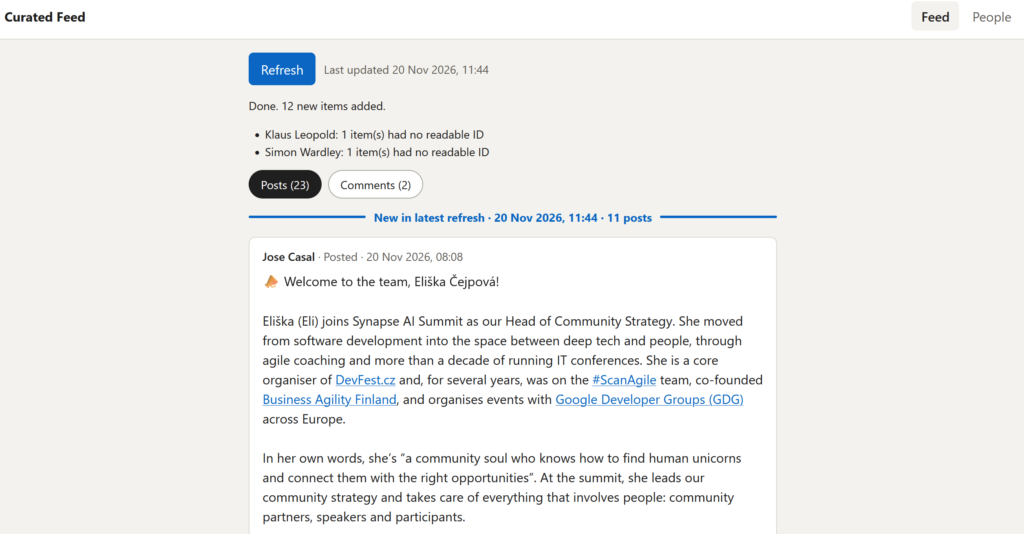
The content gathering part may be clunky, way beyond what I would weather. The aesthetics may not be anywhere close to what your run-of-the-mill digital product offers. The value here is the content. And that’s one thing the prototype does well.
A side note: In the past, I claimed that homebrewed products will not become a threat to digital product development as we know it. And here I am, building my own homebrewed thing to sidestep LinkedIn. Ain’t I a hypocrite? OK, so one, I still use LinkedIn just the same. If anything, it’s like an extension, not a replacement. And two, from a tech perspective, my prototype is crap. And it will likely stay so. I have zero intention of investing effort into major improvements, even where it objectively sucks (loading the new content is like half an hour).
How Does It Work?
The solution is as simple as it gets. It only pulls posts from people I cherry-picked. Remember? People whose content I care about. All my interactions happen on LinkedIn, same as they did so far.
That is, save for the fact that I ignore the feed altogether. In the past, I’d sometimes doomscroll hoping to see these rare pearls in the mud. Now? I’d just run the content refresh in my “curated feed” and get back to it once it’s done.
If I find anything interesting, the link gets me back to LinkedIn, where I can react or comment or share or whatever. I consciously decided against any active interactions through my prototype, even if it might have been more convenient. I’m one click away from the actual post anyway. And I feel safer if generated, unreviewed code does not do anything on my behalf.
Also, simple content scraping works through any LinkedIn profile, so I don’t even need to hand over the keys to my account. And yeah, I know pulling content from LinkedIn is murky at best. But unless they start doing something about prevalent AI agents spraying their slop comments everywhere for “engagement,” I feel it’s fair game.
Did I Fix My LinkedIn Feed?
After a couple of weeks of using the prototype every workday, it works like a breeze. On any given day, I react to 20%-50% of the posts I see, where a reaction is anything from clicking “like” to writing a comment under a post. The benchmark was 0%-5% on the actual LinkedIn feed.
The percentage of genuinely uninteresting stuff is steady below one-third, often much less, while LinkedIn’s algorithm is never below 80% and typically hovers above 90%.
Note: The numbers are estimates. Even if they’re a bit off, though, the gap is huge.
What’s more, because I keep reacting to the stuff from people I care about, I feed the algorithm, for what it’s worth. Not that I see much difference, but it’s not like I invest any extra effort either.
Most importantly, the value-to-shit ratio is through the roof. It’s like the good old RSS reader experience from the 2000s. Except it’s all from LinkedIn, which doesn’t offer RSS.
Genuine Human Connection
The fundamental difference between the standard LinkedIn feed and my custom prototype is that the former aims for engagement (counted as screen time), while the latter revolves around human connection.
It makes sense. LinkedIn wants me glued to the screen for as long as it can, as that translates to more ad revenue for them. I, on the other hand, would rather use it as a professional social network for people I care about. Those goals are largely at odds.
I mean, sure, I’m so much more likely to interact with “my people,” and reactions are what LinkedIn wants from me. Yet, overall, I spend *less* time on the platform as I only open the posts I know to be interesting in the first place. Also, coincidentally, there are zero ads in my experimental feed.
Again, it’s like in the blogging heyday of the 2000s. You chose to follow someone’s RSS because you believed it was interesting. When there was a comment, it came from an actual human who took time to type it. We were in it to share whatever we thought might be valuable, but also for genuine human connection.
Small wonder that when I first met people like Johanna Rothman, or Jabe Bloom, or Jim Benson (or many others), it felt like we already knew each other. All the prior interactions had built the connection before we had a chance to bump into each other in the meatspace.
The “social” platforms, as they are right now, promise to give us that opportunity, but in reality they make it borderline impossible. The LinkedIns of this world might have monopolized how we share content and network, but if AI gave us one thing, it’s tools to skip the mud and at least have a shot at finding some pearls.
Relevant articles that broaden the context:
I’m old-school. I write the words myself: 웃 https://okhuman.com/euYKog
Leave a Reply